From bedroom music to international tours, Lucy Bedroque has built a career on refusing to be categorised. The 20-year-old enigma talks about creative freedom, internet criticism and making music without limits.
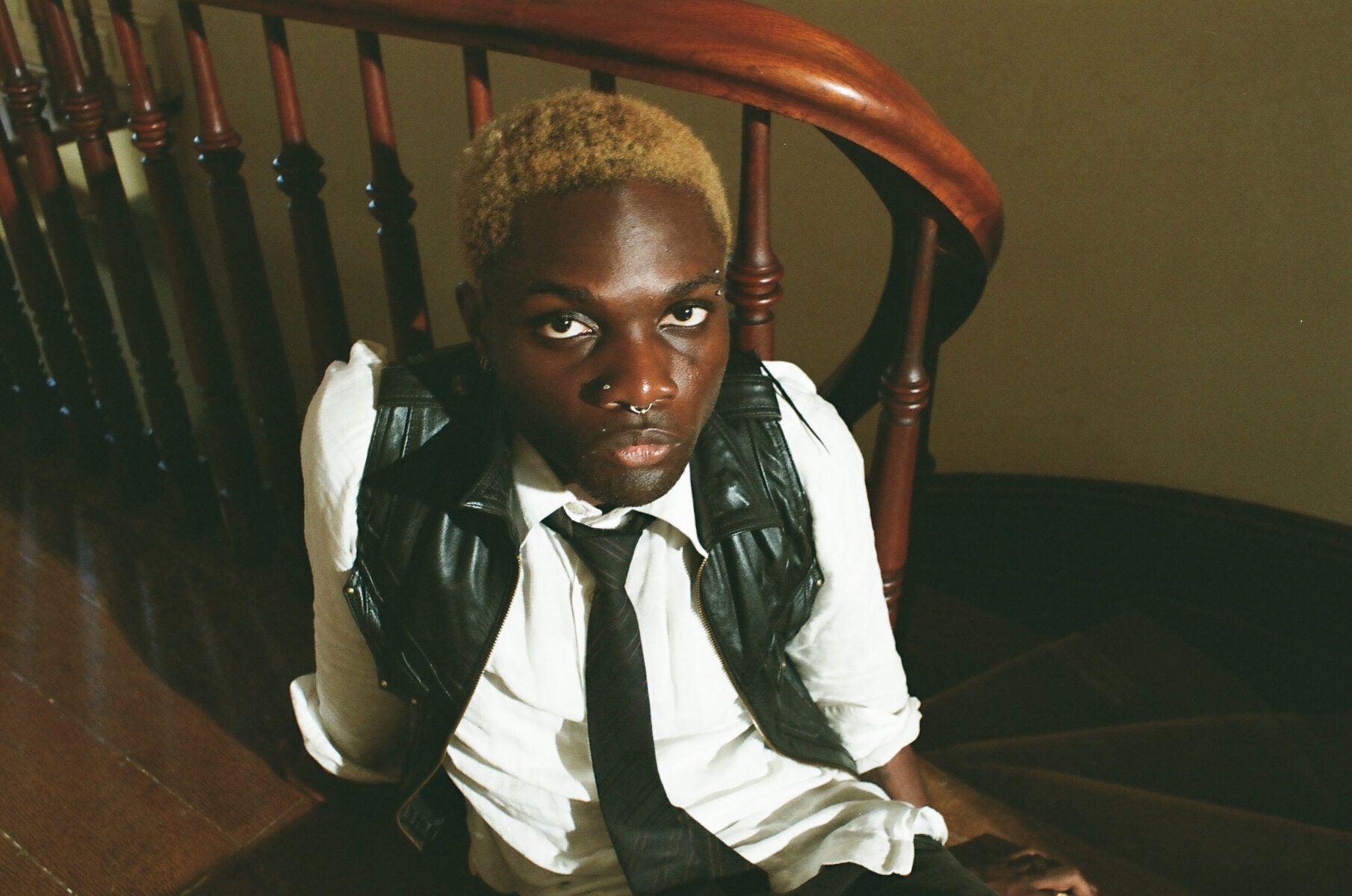
Lucy Bedroque is sitting backstage at EartH in Hackney. It’s 6:30pm – three hours before they’re set to perform and thirty minutes before doors open – and there’s already a queue of hundreds of fans lining up outside. The audience is no surprise to Bedroque. Their gigs always attract a crowd of loyal fans who are known for their wild behaviour – their show in Atlanta attracted several biters – and their first gig in London, a week earlier, was no different. “It was chill, but they weren’t too nonchalant. I have had very nonchalant crowds here and there in North America,” they laugh. “So I do appreciate people being able to turn up.”
Bedroque’s soundcheck has run late and so their managers are scurrying around to make up time, but the artist is calm. “I don’t have anything to worry about, I’m just having so much fun,” they reflect. “People come to see me, they come to these shows and they love it. And in my mind, I’m like: ‘Okay, I’m doing something right.’”
And by all accounts, they are doing something right. At just 20 years old, Lucy Bedroque – stage name of the New York born, LA raised Jeremiah Jabulani Mark – has released albums and mixtapes, co-founded a genre (maplekore – an underground, internet rap microgenre inspired by the South Korean MMORPG Maplestory), and toured the world. Alongside their music, Bedroque has created a visual world – inspired as much by emo culture and noughties rap, to anime and horror films.
For others, this would make up a lifetime of achievements, but for Bedroque, it’s feeling increasingly normal. “When I dropped the last mixtape, I was just constantly checking, checking, checking everything,” they explain. “But I’m a lot more calm now, there’s less angst compared to the last time I dropped music.”
Bedroque’s latest album, c, was released in late September, which means that their emergent tranquillity has come at a good time. Since its release, c has been described as “uncompromising and confrontational” by Pitchfork and Bedroque has already been on a multi-country tour which has meant they haven’t had too much time to think about the reception. “Number one, I just have a lot going on. Number two, I’m on tour, you know?” they joke.
The fact that Bedroque feels positively about c’s release seems apt.t was exactly how they felt making it. When they were creating their first album, Sisterhood, they knew they were concocting an ambitious project; its follow-up, the mixtape Unmusique, was intentionally lighter and gave Bedroque the chance to experiment – and they took lessons from both of those albums for their newest. “C was probably the most fun project I’ve worked on,” they explain. “It wasn’t too ambitious. It’s not an album that makes you think about anything deeply or anything like that.”
That’s why a single phase shaped how they approached this project. “It’s like a guilty pleasure album,” they say with a wry smile. From the lyrics and the flow to the production and the mixing, there was a single brief. “I just did it with a certain swag,” they state. “And I’m like: You know what? This is cool.”
And while guilty pleasure came to define the album’s perspective, guilty pleasures became the theme of its content. “There’s a lot of sex on this album. There’s so much, just so much sex,” they say, before clarifying. “It doesn’t even pertain to me to be honest.” Bedroque wanted the album to speak to the impure thoughts that people had – the ones that they didn’t always want to admit they were thinking – and push people to embrace them. For the ones that would be free enough to let themselves go, Bedroque knew that they’d find a home. “That’s why it’s the guilty pleasure album, because people listen to it and they fuck with it,” they laugh.
Bedroque also knew that for every person who got it, there’d be another who refused to open up. “You’re not really gonna understand it if you refuse to come to terms with the fact that you do believe those things,” they say. Bedroque knows that their work’s reception isn’t just about inherent value, but also about how its listeners come to it, which is why criticism doesn’t faze them. “I don’t mind people who critique my music, at least people who have mindful things to say about the music. That’s why I’m not mad about a 6 from [Antony] Fantano. He made pretty fair points. That’s just his truth,” they explain.
More than anything, though, Bedroque knows that creating music that is truly singular will mean that it’s legible to a small audience and misunderstood by a larger one. “I don’t think there’s anything objectively wrong with a 6 or any sort of rating that, like, may seem like: oh my God, what the fuck?” they explain. “People are very opinionated, and that’s how it’ll always be. There’s no objective truth.”
Since receiving more focus though, they’ve also started to encounter less generous audiences. “There are people that don’t have it in them to critique, they just kind of hate. There’s nothing I can really do with that,” they reflect. Even receiving that kind of attention feels wild for Bedroque, who began their career creating music from their bedroom with an audience that remained thoroughly within the subcultures. “I was at a point where I didn’t really have any haters at all,” they laugh. “And it felt kind of weird because the music I made back then didn’t really live up to what I do now.”
With their music in the hands of a wider public, Bedroque has found themselves increasingly categorised, an experience which can feel trapping. “People kind of need the labels,” they explain. Bedroque has been labelled in every way imaginable and, although they brush these labels off, they’re quick to list every miscategorisation. “I don’t like the hyperpop label. I don’t like the digicore label. I don’t like the sigilkore label. I don’t like the pop label,” they say. “Anything they’ve labelled “Fête de la Vanille” [their most recent EP] is kind of what it’s not.”
For Bedroque, these labels are both too simple and too complex to explain them. “At the end of the day, I’m a hip hop artist, I’m like an electronic artist, I’m a rapper,” they explain. “But I don’t really fall into a box, and I don’t think I’ll ever fall into a box. I’ve always been all over the place, and that’s just how it will be.” Rather than trying to define themselves by these genres, Bedroque wants to traverse them. “I want to be that artist where you can group me in different genres across my albums and discography. I think Lucy Bedroque will remain as whatever the fuck I feel like making in the moment.”
“So sure, I wouldn’t be upset if someone called me a sigilkore artist. I don’t really mind it too much because I know what I make at the end of the day. What I make is infinite.”
Listen to c…
Words – Rob Corsini


