Two years after the Chilean artist’s breakout debut, epistolares, comes her sophomore album, lucy miró al mundo y notó que está girando. On it, the 22-year-old falls in love, hands over her diary and lets the mistakes stay.
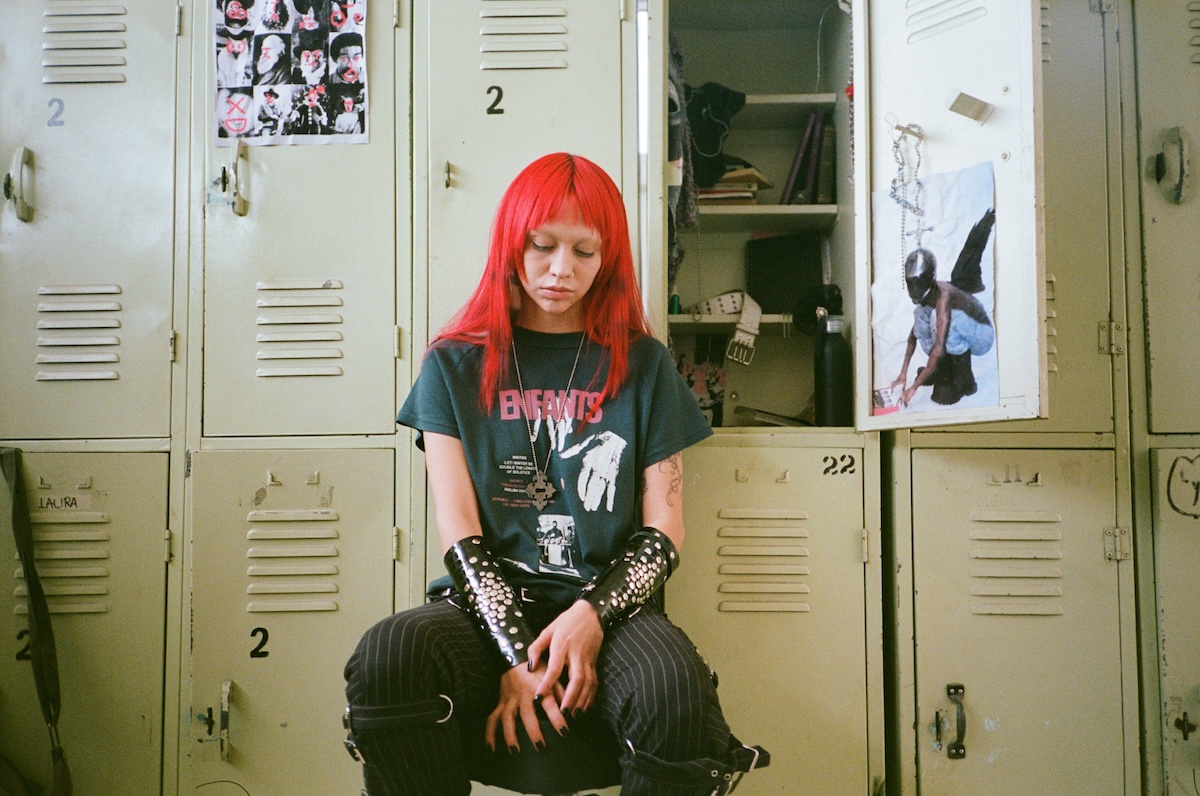
“Morir de pie es morir también”, sings Fernanda Sepúlveda, better known as AKRIILA, in “partedemipartedeti”, a track from her new album. The lyric translates to “Dying on your feet is still dying,” which draws on a long-disputed phrase, “es mejor morir de pie que vivir de rodillas” (“it is better to die on your feet than to live on your knees”), attributed to Dolores Ibárruri, La Pasionaria, in 1936, as Spanish Republicans resisted fascism in the Civil War. The line has been claimed by others ever since, often credited to Mexican revolutionary Emiliano Zapata, or wrongly pinned on Che Guevara.
Whoever said it first, the meaning has stayed the same: dignity is worth more than survival, and defiance is the only honourable way to face an oppressor. AKRIILA keeps the cadence but removes its comfort. Where the original sets heroic death against shameful life, she flattens the contrast, expressing that standing tall doesn’t spare you, and that the composure you hold through heartbreak is still a way of dying. It is one of many unconventional references used brilliantly to express how she sees the world, turning a once political rallying cry into a confession: surviving a loss with your head high can feel just as final as collapsing.
At only 22 years old, the Chilean artist has made the most personal music of her career so far with her sophomore record, lucy miró al mundo y notó que está girando. The body of work leans into soft rock and acoustic sounds without entirely dropping her usual maximalist production, whether through the flutes that rise out of the digicore at the end of “partedemipartedeti” or the gentle guitars abruptly interrupted by glitchy drums throughout “roger.” AKRIILA is also in love, and you can hear it in her voice and in lyrics that go deeper than before, digging into self-doubt, loneliness, salvation, codependency, and, above all, the many dimensions of the central emotion. The single “roger” is named after her girlfriend’s stuffed crocodile, and her girlfriend appears on the single’s cover. “I wanted it to be vulnerable, and a record you come to when you’re sad or hopeless, or happy,” she says. The visuals that accompany this era are just as surreal: the video for “partedemipartedeti” follows a puppet version of her, born from her own heart, strolling around Tokyo and echoing the lyrics through a genuinely beautiful but strange lens.
She started making music in her room in Maipú, Chile, during the COVID-19 quarantine. Since then, she has risen to lead a new generation of alternative Latin artists. She has gathered more than 300 million streams on Spotify, earned critical acclaim and rave reviews from fans, played sold-out shows around the world, and collaborated with Jane Remover, Latin Mafia, Bb trickz, Guitarricadelafuente, umru, etc. She pulls from underground rap, reggaeton, hyperpop, and electronic music into a strange mix that never settles into a single genre, and many younger artists have been working in its shadow since the release of her astonishing debut album, epistolares, in 2024. It’s all a “collage of the music that I love,” she says. Her references range widely, from The Beatles, whose “Lucy in the Sky with Diamonds” and “While My Guitar Gently Weeps” inspired the new record’s title, to Cocteau Twins, Clairo, Björk, Sui Generis, anime, and more.
AKRIILA is young enough that her story is still being written, but she already talks like someone who knows exactly what she wants and what she doesn’t want to repeat. epistolares made her name; lucy miró al mundo y notó que está girando establishes her as an artist on her own path. She is wary of the calculation that can creep into music; she would rather keep a phrase that feels right than a perfect one, and she is deliberately vague about what comes next. Asked about the future, she offers only that there are many things in her head and that the work, for now, is letting this record breathe. Whatever follows is likely to be as rebellious and as exposed as the lines she chose to keep.
Speaking with Wonderland, AKRIILA discusses the current landscape of alternative Latin music, her collaborators, touring, and the records that shaped lucy miró al mundo y notó que está girando.
Listen to the album…
Read the interview…
Congrats on the release of lucy miró al mundo y notó que está girando. It reflects a very beautiful and intentional direction in your career: softer sounds, lyrics filled with hope and doubt, and especially the vulnerability of being in love.
Thank you, that means a lot, and it was exactly my intention.
Apart from all the references you’ve mentioned before, including anime, South American rock like Sui Generis, shoegaze bands such as Cocteau Twins and The Sundays, and the title being inspired by “Lucy in the Sky with Diamonds” and “While My Guitar Gently Weeps” by The Beatles, how did you tackle all these inspirations when you began creating the record?
I’ve always loved collage and referencing. I like to shout out art that I love, and there are many lyrics or phrases that I interpolate into my own music. I felt it would be a nice exercise for this record. With epistolares we sampled a lot, but with lucy I wanted to take that same idea beyond the music, into ideas and concepts. At the end of the day, I build my personality based on what I identify with, the areas where I feel comfortable. In that sense, it felt great to work on a project where I could connect the dots and polish them based on how I expect them to sound and what I like.
Autotune has become a staple of your music. You’ve said you like it because it helps you polish something real and lets you leave a phrase the way it first came out instead of recording it again “correctly.” With this record feeling so deliberate and, in a way, so analog, with more flutes, piano, and guitars, how do you reconcile letting a mistake slide with a sound that feels so intentional and carefully crafted?
I often view my voice as a type of instrument. I prioritise my lyrics, but I also care about the way I speak and convey emotions. I feel that music can often become overly calculated, whether it’s the melody, the lyrics, or the recording process itself, so I always record in a space where I feel comfortable. If a word isn’t technically perfect but feels right, I keep it. Sometimes, if I overthink the delivery, that quality and emotion get lost. That’s why I love Cocteau Twins: half the time you don’t really know what they’re saying, but it makes you feel something.
When I first listened to the record, it reminded me in many ways of Heaven or Las Vegas by Cocteau Twins, so it makes sense that they were a clear inspiration. Beyond the music itself, I was personally fascinated by the video for “partedemipartedeti.” I think it reflects, in a very original and creative way, the uncertainty and loneliness of love. I’d like to ask about the creative process behind the visuals, whether in the videos or the album cover. Was there something you wanted to say there that you felt the music alone didn’t express?
I really like the visual side of music, and it keeps me entertained. When I’m making covers or a series of videos, I like them to be coherent with each other. I really liked the idea of the videos being fantastical, or kind of unreal. There was “roger,” with the cardboard, and “suave,” which was a narrative of Jane (Remover) and me as sisters in another universe, with red hair.
“partedemipartedeti” was an idea from Lucas (Moreno), who is my creative director. We spent a long time thinking about it, and we had the idea of a heart transplant. We found it beautiful to interpret the lyrics that way, with the doll and the super big heart, so people might also think I’m pregnant. The mix of all those ideas was beautiful to me. The music is very poppy, but the videos are weird, and I liked that. I always try to do something digestible but alternative, something you can connect with in many ways.
Regarding the covers, I liked the coherence of Japanese designs, which is why I put these elements on the left side, like the numbers and the chords. In the single covers, you never see me. I wanted to save myself for the end: the album cover. I knew I wanted to work with Emilio (de la Rosa from LATIN MAFIA). He is a close friend, and I like his photography because it has a lot of light and a lot of white. That conveyed hope to me. The references were Isn’t Anything by my bloody valentine, Homogenic by Björk, and Stories from the City, Stories from the Sea by PJ Harvey. They all have really special symbolism, and I wanted to create a collage from those three covers I like.
You just finished the US and EU/UK leg of the tour. I had the chance to attend your show in Madrid, and I thought it was a perfect mix of your repertoire and, at the same time, a great presentation of the new material. How are you feeling about the live reception of the record, and how are you preparing for your audience in Latin America to receive it?
I’d gotten really tired of the epistolares show; it was too much, with so much happening. What I like about this one is that you have highs and lows. I really like starting with the new songs, which are a bit more ethereal and rockier, then moving into something more guitar-driven, then three reggaetons together, and then the calmer songs at the end. That rise and fall entertains me a lot as a spectator. If I go to a show and everything feels the same, I get really bored.
Honestly, I feel like people in Madrid received the show with a lot of energy, which is why I’m so excited about Latin America. I feel that in Europe, people are very observant and very perfectionist, and that’s great, but I also really like the jumping, the movement, the screaming. Madrid, as a Spanish-speaking city, was really “bacán” (cool), and I remember it very, very fondly. That’s why I want to jump into Latin America already, because the context is more fun. I’m really looking forward to it.
You once said that you’re quite sensitive and feel everything too much. Now that lucy has been out for almost a month, do you still feel it as a kind of personal diary, or do you feel it belongs more to the people than to you?
I think the saddest thing about releasing any work is that it no longer belongs to you because now everyone can have an opinion about it. That’s fine; that’s what music is for; I’m the same way with the music I consume. But it makes me a bit sad that creating it is so sensitive for me, and that after I show it, it becomes something more professional, something that belongs to everyone, when in reality, at one point, it was just mine. That sensitivity causes me a feeling of discomfort, because these are super intimate things: the reflections, the lyrics, my state of mind at that moment. It comes from a very low point in my life, so I’m afraid of people reading it and picking up on it.
But at the same time, that’s what I like about music. In the end you hand over that diary and it lives as what it is. I hope it comes across the way I wanted it to, with a lot of vulnerability, and that it resonates with a lot of people. It also happened with this album: I said, “I don’t want it to be epistolares, I don’t want it to be something people put on to party.” I was thinking a lot about three albums that were very key for me: Rebeldes by Alex Anwandter, Immunity by Clairo, and Debut by Björk. I listen to those three a lot when I’m sad, and I wanted lucy to be that. I wanted it to be vulnerable, a record you come to when you’re sad, hopeless, or even happy, rather than something repetitive.
On epistolares, even though it’s a very upbeat record, you have a couple of very personal songs, such as “carta a mi papá.” Was there anything on lucy that cost you that same level of exposure?
I feel like “lucy” a bit. There are several painful lyrics across the whole album, but that one is very strange for me, because it also has a lot of personification, and I think that’s also why it feels much more open. It was also really hard to write about home and feeling alone.
“carta a mi papá” is very literal: it’s called a letter to my dad, so there’s not much room to get into it. “lucy,” on the other hand, is itself a big metaphor for how I see life and how I’ve carried myself through it at certain moments. It was one of the last songs I made, and it was really hard for me to put into words. Along with “thank you, music!”, it’s my favourite song because it moves me the most and makes me feel the most alive.
You worked with producer Heartgaze and songwriter Vinco, who have both become an essential part of your music, on this record, and also brought in new collaborators like umru. How would you describe your collaborative process with them?
Vinco and Heartgaze are my best friends, so we always work together. I really like production and get very involved and detail-oriented. But at the same time, I trust them a lot because they’re my great friends. We are building something together, and as much as I like working with other producers, things stop having as much coherence and stop feeling like me. It’s much more comfortable for me to work with people whose music I already like, people I get along with really well. I don’t need anything else.
With umru, we didn’t have a starting point for closing out the album, and we wanted a song that felt like the climax. Then the possibility of working with him came up when he was in Chile. We needed the perspective of someone else who would find what was missing, and that was literally what he did. It ended up being “el mundo y yo,” which became an essential part of the record.
In recent years we’ve seen quite a few Latin artists, whether it’s you, iza tkm, Six Sex, Safety Trance, Corridos Ketamina, and so on, entering international alternative spaces without fully translating their music or assimilating it to other sounds and genres, keeping all their customs and inspirations quite clear. Do you feel part of this, and how do you see it from the inside, as an artist?
Yes, I think a really beautiful core is forming, a Latin American one more than anything. The world is ready to hear more Latin music, and it’s lovely that it’s becoming more current and that the sound is expanding. Obviously, we have people like Bad Bunny and Tokischa leading the way, but there’s also a world beyond the American and European scenes for people looking for more alternative music. Latin America is home to so many people around the world, and even though it’s growing, the scene is still very small globally in terms of what we could achieve.
The industry must grow, establish good roots, and go out into the world. I get along with a lot of the people you’ve just mentioned. Iza, for example, is my best friend, and it’s really nice to be able to work together in the same industry, in the same kind of music and learn from each other.
Besides being very vocal about your roots, you’ve also never filtered your identity or sexuality, as shown by your trademark line “Hot gays listen to Akriila.” You’ve become a reference point for a new generation of queer Latin American artists, which I think is really necessary, especially on a continent still so resistant to diversity. How do you carry that position? And do you think the landscape has been gradually changing?
Yes. The people leading alternative music are queer women, especially trans women. There’s a really strong community. I’m from a generation of artists much further back than other people, like Arca, for example, who led the way for many. I don’t know many other lesbians in the Latin scene making alternative music, but I also try not to think about it so much. I like representing it, singing it, and it not being a barrier I have to get through. In my space, it’s very normalised now.
Alternative music always comes largely from the community, in the end. It’s the kind of music that mostly women or gay men consume. We have our own niche, and we enjoy it more than straight people do most of the time. It’s a good niche, and I love that.
What are the next plans for AKRIILA? How do you plan to extend this era, whether through collaborations, another deluxe…? Or is the next step something totally different?
No, I can’t say anything yet. There are a lot of things in my head, and I don’t know whether they’re going to happen or not. But I do have a lot of things in mind, honestly. The album is only just coming out. I’m trying to get it out there and have it be good in its form, but I don’t know. I think we keep building ourselves up and taking ourselves apart.
Words – Marcos Sanoja


