With her fourth album, Lux, Rosalía carries you from earth to light and turns listening into a sacred experience.

Not long ago, I sat for hours in a garden at night with a friend visiting from Madrid, talking about what she called the Magic. The Magic, she described, is the feeling you get when something you wanted so badly becomes true. It’s what happens when, through exercising your creative practice, you reach a climax in which you find you’ve created exactly what you were looking for, and in consequence, you achieve things you always wanted and you live things that once felt very out of reach. Pure luck, hard work, divine intervention or Magic, is something you might only understand if you have felt it before; is the same pulse that runs through Rosalía’s Lux.
Success is the product of hard work, and Rosalía, born in Sant Esteve de Sesrovires, a small town of 8000 people outside Barcelona, believes in effort as a ritual. At thirteen, she found Camarón de la Isla, known for revolutionising flamenco in the 20th century, and traditional folk sounds, and maybe that’s when she found her faith in sound itself. I, like many in Spain, first heard Rosalía’s voice in “Antes the Morirme”, a song in collaboration with Madrid’s C. Tangana, a trap artist, in 2016. That summer, wherever you’d go in my town in Galicia, you’d hear the song’s catchy chorus from a teenager’s speaker. It wasn’t necessarily the song that made me connect to her work; it was her unique artistic sensibility, refined visual language and lyrical messages that, until then, I had never seen in the Spanish musical scene.
Soon after came Los Ángeles, a disruptive flamenco album in collaboration with experimental producer Raúl Refree. Flamenco, born in Andalucía, sacred and untouchable, is an intuitive art form passed down through generations, performed with just a voice, handclaps, heel stomps, and sometimes a guitar, something few dared to play with. When Rosalía dared to experiment with this genre, of course facing critiques from those called “purists,” flamenco was reintroduced to a generation that deemed it as idle or archaic. I was 14 when Rosalia was touring the country for Los Ángeles, and her concerts that summer were free. To attend you had to collect a ticket in person, and there were none left by the time I showed up, so I DMed her and she tried to sort me out. I sent her so many messages that year, and she always replied. I now think I must have been the only fan in her DMs back then.
Her real breakthrough happened with El Mal Querer, which came out on the 2nd of November 2018, my 17th birthday. The album, which she had conceptualised as her college thesis, received critical acclaim universally for its experimental production and the use of flamenco elements mixed with pop and urban music. It was then followed by her third full-length, Motomami, a genre-bending piece of work with Caribbean influences, and the best-reviewed album of Metacritic in 2022, she already had cemented her status as a global popstar. I got to see it live in London that year, and every time I play “G3 N15”, the song Rosalia wrote for a younger cousin, I think of my brother Sandro who I don’t get to see as often as I would like.
Now with Lux, Latin for light, the artist from Catalonia ascends to a place few others reach. As I write this, the morning after listening to Lux for the first time, I am so moved. I keep writing and rewriting ideas and erasing words and starting again because I know whatever I say will not do it justice. But I am immensely inspired. This maximalist piece of work could only have been created by Rosalía, the most ambitious popstar in today’s landscape.
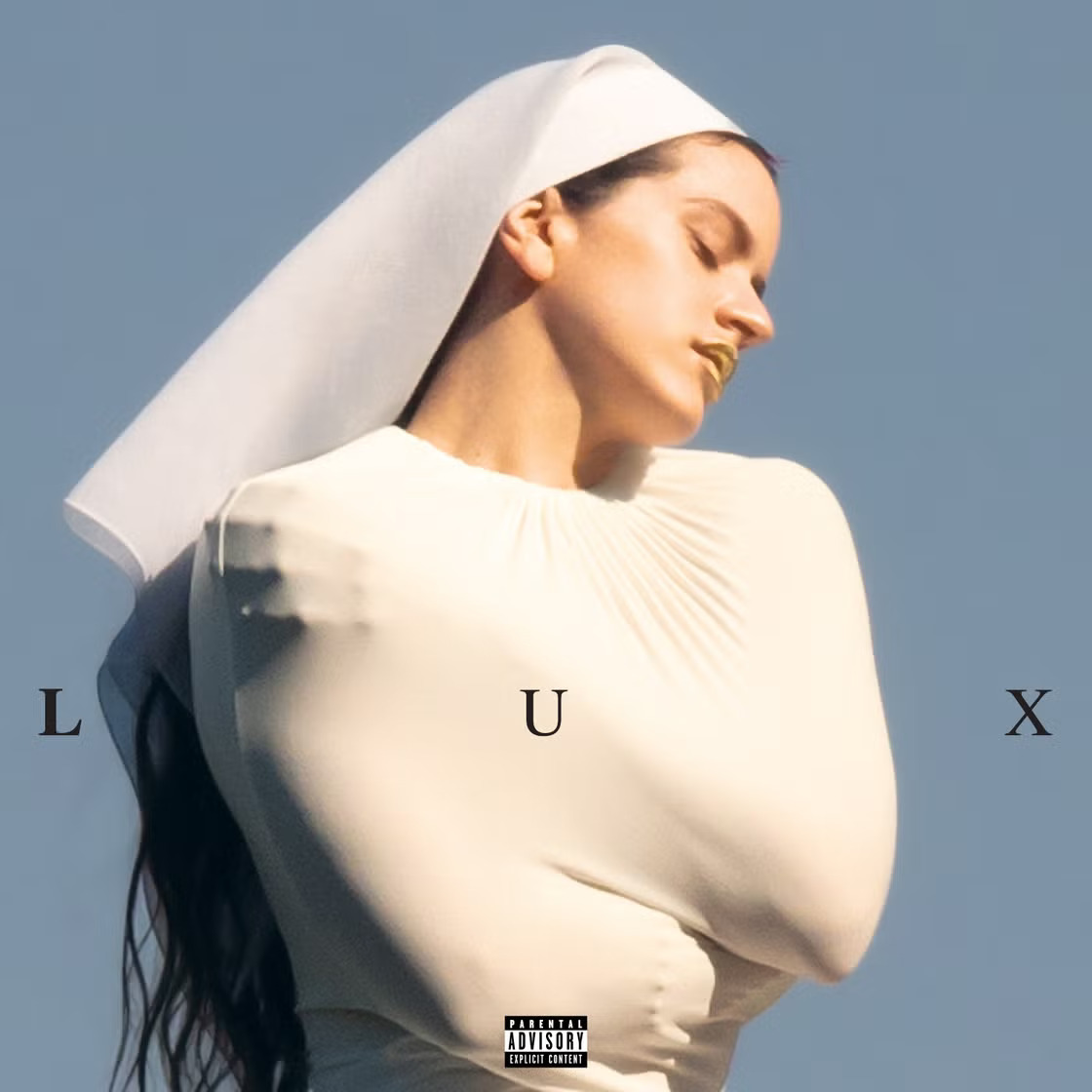
Divided in four acts, Lux tells a journey from the terrestrial grounds to celestial helms, celebrating feminine mystique. Full of religious symbols and exploring themes from love to death and the divine, this album is the impeccable result of three years of constant exercise, research and practice. Rosalía spent a full year reading theology, studying, mapping out and hearing stories from female saints all over the world, such as Santa Teresa de Jesús, Santa Rosa de Lima and polymath Hildegarda de Bingen, before dedicating another whole year to writing lyrics, in 14 languages, including Latin, Arabic, Catalan, Mandarin Chinese, Ukrainian, Hebrew, Portuguese, et others, with the help from professional translators, language tutors. In an interview with Zane Lowe she insists that in this album, the music is in service of the lyrics, and you can tell every word moves the album and sets its tone.
Blessed is the only word that comes to mind when trying to describe the experience of listening to Luxx, thirty people, her most devoted fans, are gathered in a white- draped room, a professional sound system at Sony’s event space, the only light coming from a LED screen that pulses in rhythm with the music, showing each lyric and its translation to English. It feels more like a ceremony than a listening party. The first song on the record starts playing, “Sexo, Llantas y Violencia” (Sex, Wheels and Violence), and it immediately moves the room to tears.
The tone is set from the beginning: operatic vocals and orchestral sounds juxtaposed with the sharpness of a synthesizer and raw, sometimes violent lyrics. These constant tensions persist throughout the record. When the music softens later on, like in the song “La Perla”, one that will probably be posted on Instagram stories countless times for a certain someone to see, the sweetness of the melody doesn’t hide the sting. The lyrics, where she calls an ex-partner an “emotional terrorist” and the “local disappointment,” are carried by a poppy, almost carefree sound.
The instrumental and vocals throughout the album are live, there are no loops and the singer and songwriter insists that the album should feel human. The intensity built by the highness and elevation of the instrumental and the vocals was such that after “Mio Cristo Piange Diamanti”, a monumental opera in Italian, the attendees let out a collective sigh of relief as the song was over. I feel like I won’t be able to breathe again, or listen to anything else again. The relief comes from songs like “Novia Robotika”, where the singular intro makes me look at the person next to me with an astonished look, or “Sauvignon Blanc”, potentially the song I will play when I elope one day.
The first lines of “Memória” make me forget the song was in Portuguese and I feel like she was singing a Fado in my mother tongue. I am not a fan of tattoos but, I might need Patti Smith’s words etched into my skin for eternity, in “La Yugular” the New York legend recites:
Seven heavens? Big deal! / I wanna see the eighth heaven, tenth heaven, thousandth heaven / You know, it’s like… break on through the other side! / It’s just like going through one door. / One door isn’t enough, a million doors aren’t enough.
To me, that passage explains Rosalía’s entire approach to this record – her desire to reach divine perfection through music and commitment to transformation, even as she later acknowledges that only
God can reach true perfection. As the music ends, after the both tragic and hopeful “Magnolias”, suspended between grief and exhilaration, no one moves. It is as if a spell still holds us, as if speaking might break whatever grace had entered the room. While I am not religious, this feels like the closest I’ve ever come to transcendence, and I know that whatever I do with my life I will chase this feeling.
I am convinced that for the first time in years, thanks to Rosalía, we truly experienced what my friend called the Magic.
Listen to the album…
Words – Moira González


