As Wonderland premieres the first part of her incredible In Power film series, Lauren Luxenberg explains her process, forthcoming exhibition, and the core messaging of the project.

Snapshots of complexity, shards of beauty and strife; In Power finds potency in the smallest of moments. The new eight part short film series from revered artist and filmmaker Lauren Luxenberg is a deeply compelling and piercingly resonant portrayal of femininity, self-worth and empowerment, shot through a 35mm lens and sprawling across video, performance and musical composition. The latter facet comes courtesy of a score written by Nathan Coen, of Baby Reindeer acclaim, and Harry Ling—aka drummer and producer Mackwood.
Accompanying the series of films, a one night only exhibition will be held at The Art House by Acrylicize on 24th April, with the space regenerated into a multi-media immersive experience that will be an exclusive opportunity to take in the art in a unique manner, with props, DJ sets from Mala, Howe and God Bless Chennessy.
The eight films, created by a predominantly female crew, are all unique pieces in their own right, but are sewn together into a wider thematic and narrative tapestry that tackles the evolving and intricate way that women view themselves, and are viewed within society. Luxenberg, born in Canada, with time spent in Medellín, Columbia and now London based, graces the films with her individualistic perception, in what is a broadly personal project for the polymath.
The first episode of the In Power series is premiered exclusively by Wonderland below, with the ensuing seven set for release, one per day, after the exhibition next week. Luxenberg joins us here, to discuss the process of creating the opus, how her own experiences informed the work, and what conversations she wants to add to.
Exclusively watch the first episode of In Power below…
Read the interview…
Where did the idea for the series of films first stem from?
There’s a part of me that has been quiet for a very long time, and I wanted to change that. I have spent my life responding to other peoples briefs and emotions. Telling other people’s stories. This time, I wanted to tell mine.
Ironically, the theme of this project is actually the reason I couldn’t speak out in the first place. I was lacking the sense of empowerment and confidence to be able to express myself. These 8 films explain how the false sense of empowerment has played out in my life. And they explore the misconception of feeling empowered.
It turns out, these stories have a universality to them.
How have your own personal life experiences informed the film series?
Power is a peculiar thing. It is given and taken away so easily. It’s misunderstood. And it’s fragile.
My mom has battled with bipolar disorder for many years, but it wasn’t always diagnosed or identified as such. Sometimes there’s a heaviness in an environment you just feel, and don’t understand, but it feels dark. This meant that my household had a deep sadness and didn’t feel like a safe place for me. It left a sense of instability in my home.
In addition to that, I was 8 years old when I was diagnosed with ADHD, and because of this diagnosis and being medicated at such a young age, social environments were a difficult place for me. I was bullied and struggled to be part of a social community. My family most definitely supported and loved me, but it was hard for them to have the emotional capacity I really needed.
This created, at times, a sadness in me. But I learned there is a specific type of power in sadness – a kind of dark beauty that I find really intriguing, and which echoes throughout the work I think.
I grew up thinking that my family was normal, and that the experiences that I had making friends and trying to fit in and interacting with men was normal. And in recent years, I’ve realised that what I experienced led to a groundlessness – a hole in me that I tried to fill with so many things growing up that could never fill it. When your upbringing is not on solid ground it’s easy to be uprooted. A sort of internal power vacuum. Behind this hides something, which is actually how fragile we can be on the inside when we don’t have strong foundations.
These have become a set of internal narratives that I battle with on a daily basis, but there’s been a realisation that they’re both unique to me, but built out of experiences that are highly relatable to women more generally.
How did you bring it to life? What influenced the visuality of the films? What was the process of creating them?
Each film is an expression of a narrative related to the misconception of power. After breaking down these internal narratives chronologically, Fin and I sat down and drew up a plan to visualise them.
They’re built out of a series of symbols. Everything in there represents a piece of me. For example, horses are representative of my relationship with my dad, and some of the photography in the films is mine, from my second home, Colombia. They are a very present animal in a lot of my work.
Some films are clear, others are really quite obscure. But each film speaks about a part of my, and women more generally, journey into womanhood.
The film ‘Still to Move’ is a reflection of an approach I have applied to my life in general; a sense that in order to develop you must also slow down and reflect – notice things. This theory then came full circle when we were conceptualising In Power: in order to understand the stories I wanted to tell, I had to stop everything and understand myself first. And this idea is how we chose to communicate the work – from the slow, revealing zooms to the stasis of the characters. At first glance they look like they could be editorial films, but the more you look, the more you see.
I can’t say I have any specific references because the biggest reference was the aesthetic of my mind. In fact I found it initially quite hard to communicate my visual ideas because I hadn’t actually seen them before.
We worked closely with DOP Josh Fry to figure out a way to tells these stories in an artistically concise way. With the help of Production Designer Ellie Beale, we built 2 hero sets (‘interior’ and ‘exterior’) which would house each host 4 of the scenes. They faced one another, meaning we could jump back and forwards between setups.
In the end, it took a team of over 40 people 2 days to shoot all 8. Big ups the producers Only Child Collective for their amazing job in pulling everything together. A further 20 or so people have been involved in the post production process. It’s been incredible how many were onboard with the ideas.
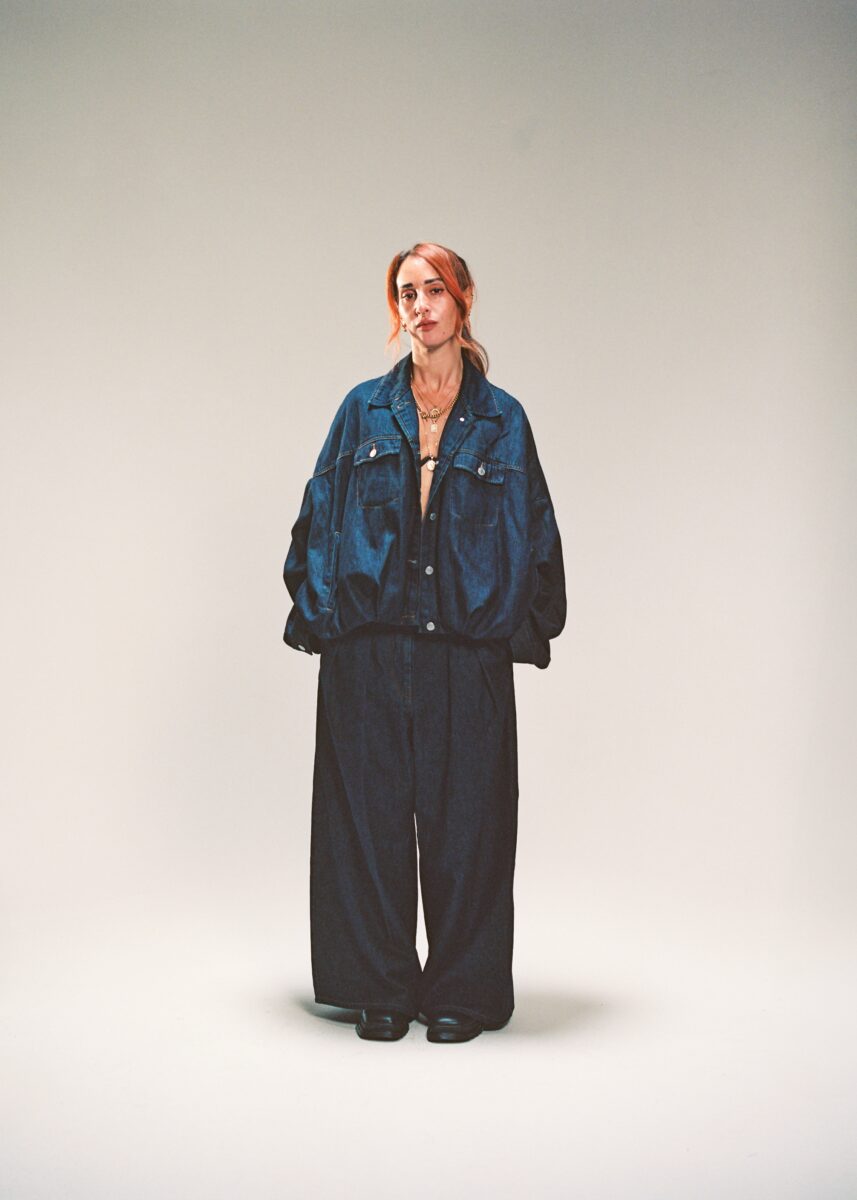
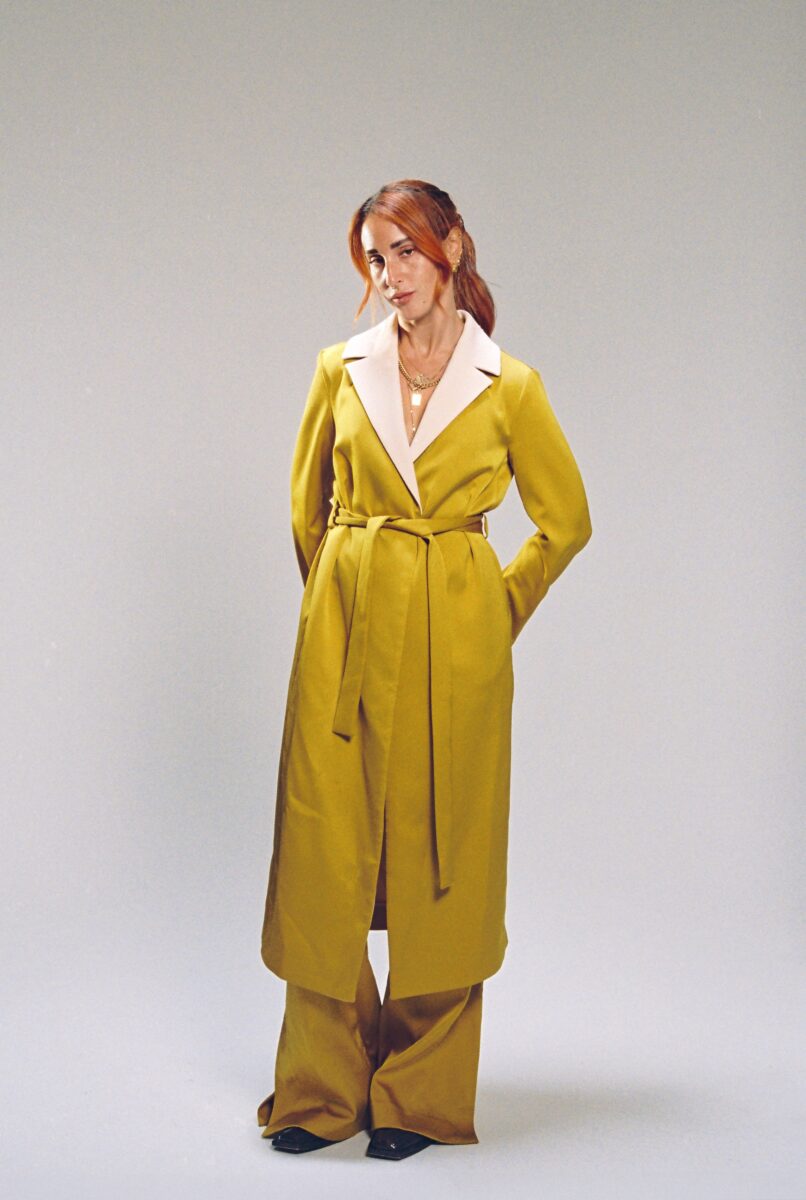
Why did you choose to shoot on 35mm?
My directing and photography career has been built out of film. 90% of what I do is on film. Film is what caused me to notice things differently and appreciate beauty in simplicity. This began the first time I got a photo back and noticed how interesting a shard of light entering a room is. It’s influenced the things I notice that I never did, and how I navigate through life. It has allowed me to see my own potential, and is the most authentic way to represent my work and my mind.
Why have you named the series In Power?
In Power was actually just the working title. We never discussed it – there was a subconscious understanding that this idea of ‘power’ was the red thread that ran through all the films. So it makes sense.
And then we realised that, in many cases, the story we’re telling is of the irony of empowerment. My external identity – the way I’m perceived – vs how I feel internally. There is an irony in how fragile power is. It’s completely conditional on external factors. You feel incredible and then maybe you go on instagram and that feeling is diminished. You have the superpower of being able to create life and it can be taken from you in an instant. Power is something that is fragile, and its presence or lack thereof is something I can track throughout my life.
The works come attached with a two-hour original composition from Nathan Coen and Harry Ling. Why did you feel that this was an essential layer to the wider project? How was working with the aforementioned composers?
Nathan Coen and Mackwood’s music drives the work’s melancholia, which in my mind as the overriding emotion present in these narratives. I needed to translate the strange, uneasy, sad but not sorrowful feelings that come up and in this way the music has almost become the soundtrack to my life.
They composed 8 tracks – a unique one for each film. On the night of the exhibition Mackwood’s band will play a 2 hour long improvisation, built out of the composition’s themes. Between them, they have brought the films to life in a way that I never imagined could be possible.
It’s an impressively multi-media project, culminated in the physical exhibition space. Did you always conceptualise the project to be such a sprawling work?
Yes. I wanted to actualise the work in every possible way and be unexpected with how we presented it. I wanted to merge directing, photography and fine art.
I was thinking a lot about how people can feel stimulated in this space. I don’t really go to galleries or anything like that, or exhibitions, and it’s because I struggle to focus when I’m in those spaces. So I wanted to create a space that’s multi-sensory.
It was Josh Fry (DoP) who initially suggested we push this beyond a screening and move into the fine art space, treating each film as a framed image that moves. Once Lucas Gabellini-Fava (Curator & Exhibition Producer) got involved everything fell into place.
What can attendees expect from the exhibition at The Art House on 24th April?
Maybe it’s better they don’t expect much, so whatever happens will surprise them.
For your perspective, how do the series of films and exhibition depict the modern struggles and triumphs of feminism?
The work as a whole explores how, for women, power is gained, lost, withheld and reclaimed. The films chart moments of ambition, control, vulnerability, and defiance, exploring the precarious nature of confidence, the tension between independence and approval, the weight of expectation, and the fleeting moments of validation that shape a woman’s sense of self.
A few years ago I began doing a new kind of therapy called EMDR. I was trying to understand more about my romantic relationships. And through the therapy, a load of things came up that I had never considered before. When I reflect on my early experiences with intimacy, I realise that I said yes to a lot of things I wish I said no to, just to fit in. At the time, these things felt normal. Looking back now, I realise they’re not. And I’m having a lot of conversations right now with women who have been in strikingly similar situations. And I’m not talking about once, I’m talking about time and time and time again. And I think that part of the modern struggle of being a woman is is looking back and realising that a lot of things that happened to you that you spent years thinking were okay, that maybe affected you, were not. And these things stay with you, even in your subconscious.
There are also similar stories about fertility woven into the work. I went through egg freezing last year, and the whole process just made me realise how we really take for granted what our bodies can do. What an incredibly powerful ability it is to create life – and as a woman you never know if you have it, or how much of it you have, or when it’s going to go away. And that anxiety is just crazy. I think about it every single day, and I know that many women do. But also as a very career driven person, knowing that it’s not something I want right now but is something which has a very limited time frame is incredibly difficult to balance.
I’m not trying to fix anything with these films. I’m just trying to give a voice to feelings that so many women have.
In terms of the first episode, why was this the inaugural piece? What lies at the core of this specific concept?
I wanted to present the films in some kind of a chronological order, which meant looking at this relationship between power and fragility quite objectively and thinking about where it all begun.
The first film is about growing up alone, even though you have a family. Because of what was happening in my household (mental health struggles), it meant that female relationships at home weren’t really available to me. It’s about growing up trying to connect to the women in your life.
I grew up in a suburb, there wasn’t much around and there was a darkness and a heaviness in my household that I couldn’t put my finger on, and I couldn’t escape. So the first film is about a failure to connect with the women in my life. And that has had an impact on how I relate to women and experience them as an adult.
This then became the point of departure for all the following films. They all began here.
What do you hope the series achieves? What conversations would you like to open and add to?
I find the fascinating thing about life is, for me, understanding how much we can understand. And that’s what this was all born out of. I think that we, especially in London, are living in a place where people are avoiding looking at themselves really, and understanding. And so there’s a lot of struggle. And I hope that this series allows people to be open to connecting a little more with themselves and trying to understand how much they truly understand about themselves, and how much they can therefore expand.
I want people to leave with a bit of perspective. Dig deeper than the surface. Just to stop for a minute to move further in themselves.
On a personal note, what’s next for you?
I am about to head back to Colombia for an exhibition of my work which explores the family relationships of local artists through a series of family portraits. I’m very excited to share it. I do a lot of work in Colombia telling stories from the community there, and it’s one of the most fulfilling parts of my artistry.
Words – Ben Tibbits
Photography – Rob Jones for Khroma Collective


