With the release of his fifth studio album, ZUKO!, Afro rap heavyweight Fireboy DML maps a journey of rediscovery through faith and humility.

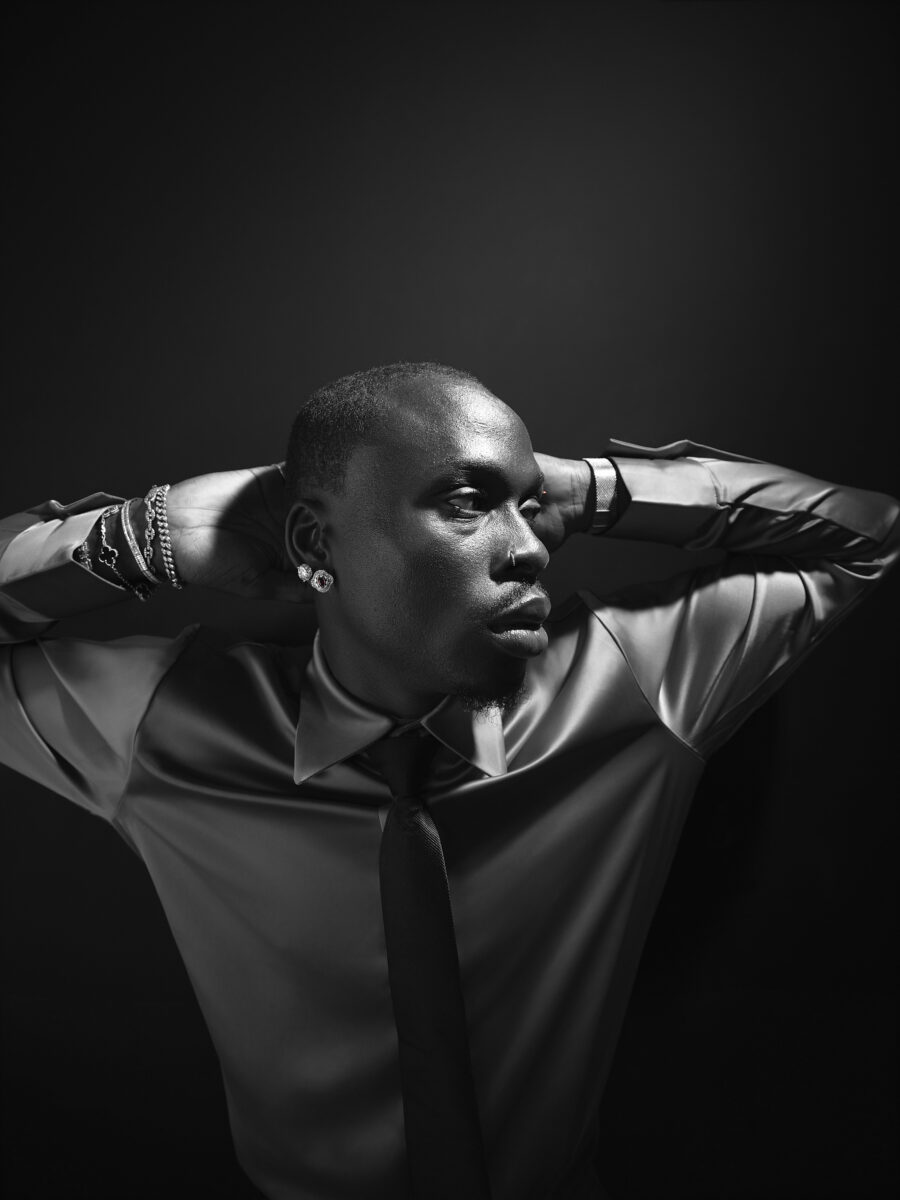
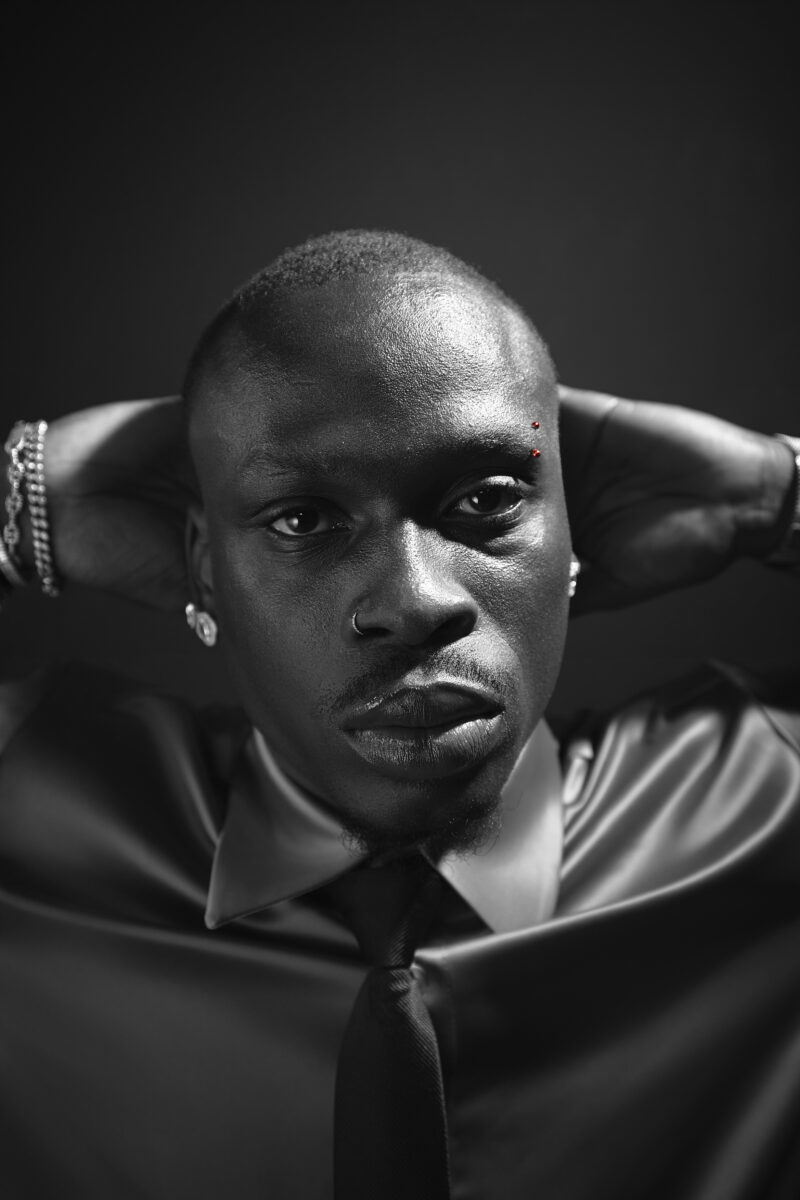
“That hair signified an era, and I needed to physically cut it off,” 30-year-old Fireboy DML explains, referencing his previous mid-length locs that, tinted black and brown in colour. “It’s been seven years; a lot has happened. It’s a new me now. So, everyone should get with the programme,” he says. The tone of the conversation between the two of us is shepherded in by a sense of maturity and clarity. A man caught between an expectation for the future and the wisdom of finding gratuity in the simplicity and convenience he can make out of life. “Also, genuinely I just wanted to feel water on my scalp when I shower,” he admits without holding back, he elaborates. “I got to that age where I started to care about things like that. Waving my locs to impress women on stage is not really something that I care about anymore.”
It was during these years of hair experimentation that Fireboy DML saw himself shine brighter than most. In 2022, Fireboy DML found global acclaim with his Ed Sheeran-featuring hit single “Peru”, reaching No.2 in the Official Charts, going Platinum in the United States and earning a BRIT Nomination for International Song of the Year. His song “Bandana” with Asake spent seven weeks at No.1 in his home nation, Nigeria. Since then,he has gone on to make songs with 21 Savage, Madonna, Justin Timberlake, and Seun Kuti.
Like his new haircut, his fifth studio album ZUKO! connotes elegance, authority, power, and leadership. The record maps his experiences with vulnerability and faith; a young man still trying to identify the narrow way of what the christianity should look like. Still figuring it out, still adapting, still learning.
From the first few seconds to its climax, the album expresses the depth of love, conflict, contention with self and others, spiritual warfare, vulnerability and resilience. It’s an album that is chasing after elements of his christian faith, but not fully grasping it. Yet despite the biblical references marked across the album, this is not a gospel.
Speaking exclusively with Wonderland, Fireboy DML discusses the meaning of his name, growing up in the church, and the wisdom that comes with age.
Listen to the album…
Read the interview…
Many people might struggle to understand your background, tribe, heritage and faith as it interconnects, but I believe it starts with your name. Could you explain the meaning of what Adedamola Oyinlola Adefolahan means?
My name, Adedamola, means royalty and wealth. Ade literally stands for crown. Ola is wealth, honour, and riches. Adedamola means royalty mixed with wealth. I’m from a royal family in Abeokuta, the capital city of Ogun State, so that’s what it means. My father did his best to stay away from Kingship. But when we were young, he always instilled in us the knowledge that we’re from a royal family. The awareness of my family lineage shaped the way I carried myself. Building my self-confidence and self-esteem did not come from me finding out I’m from a royal family. That happened when I started discovering my gift. That’s what shaped my mental strength.
You were initially in the church choir in Abeokuta, Ogun State, Nigeria. What moral values did that environment shape in you?
I didn’t really stay long to be honest. I quickly got uncomfortable not being the star of the show. It just rubbed off on my nervous system, and I only lasted two weeks, but I learned discipline as a musician. Joining the choir did not really shape my musicality that much.
Did you grow up in the church? If so, how did growing up in the church shape your principles, the way you view life, and you have consistently moved forward with the values and principles you learnt within the church?
I spent most of my formative years as a teenager in church. I grew up as a very observant kid, so I just watched people. Church is a place where you get all kinds of people. For me, in my head, every Sunday in church was just a social experiment. I saw a lot of genuineness. But my parents really instilled a lot of values in me, which I think were reinforced by church and biblical values. But my relationship with God didn’t become solid until I started living life on my own. I spent the first year in university trying out different churches and fellowships, trying to build a relationship with God.
You’ve worked with the likes of Ed Sheeran, 21 Savage, Madonna and Justin Timberlake over the years. Over time did you ever feel like you were pressured to mirror foreign sounds and dilute afrobeats?
I’m very particular about people that I collaborate with, because I would not find myself in a studio or find myself shooting a video with someone that I would have to think about the pressure to conform to their sound or anything. All my collaborations have been with people I’ve felt a connection to; with Ed Sheeran, it was seamless. I didn’t know he had recorded a verse for “Peru”, someone in my team called me and told me to check my DM’s. Meeting such a global mega superstar and getting a different perspective on life and fame was enlightening. He explained to me that he doesn’t have a phone; he doesn’t use social media. If you want to reach him, it’s email, and that’s even if you’re his friend. After making his album and touring, any small stress Ed Sheeran has, he goes on holiday with his family and just spends three weeks on the ocean on a yacht. He’s so down to earth and chill. That is the part of artists that influences.
What are the things that keep humility in you?
When I became a man, I had to find balance because our minds are powerful. My mind can deceive me and put me into a state of delusion. So, whenever something great happens to me, I immediately regulate it. I try to stay grounded. I have a very personal life, so when I’m done being a superstar, I have a very human life to come back to, and that life is so human, I automatically stay grounded when I’m back in that life. I don’t enjoy being a superstar all the time. I find my moments, enjoy my superstardom, come back, be human, make mistakes, accept it, and admit it. That’s what makes me stay grounded.
A lot was happening in the world during your first album in 2019 till now. How has the first album you created and the socio-political landscape during that time 7 years ago helped you become resilient now in the creation of your new album?
The main difference between that era and now is that this one is way more personal. I was introducing myself to the world at the time, but now I am reintroducing myself to myself and reminding people that I’m still here; I’ve just grown. Regarding social and political issues, I’m usually in a place of trying to keep my mental health balanced. I naturally always just go into creating. In 2020, SARS happened, with police brutality, which resulted in the Lekki Tollgate massacre. I remember coming out to protest, but I was also creating. I remember creating the Apollo album during that same period. Personally, I believe music isn’t supposed to always speak on exact [political] matters. We all have different opinions and experiences and there’s already a whole lot going on in Nigeria. Every day I’m always praying and talking with my boys about how our country and the people can do better.
The title of your album is called ZUKO!. I used to watch Avatar and the character Zuko experienced a lot of rejection, isolation and abuse throughout the series. He then evolved from a state of anger as the series progressed. Would you say Zuko’s experiences inform your album and mirror your own experiences?
There’s a very similar trope to the character Zuko’s trajectory in the animation and some of the things that happened in my personal life and career. The story of rediscovery and finding your spark that Zuko experienced. But also, I think it’s a cool name for the album. And Zuko has father issues, and starting the album with “DEAR FATHER,” is a cheeky reference.
On your first song on the album “DEAR FATHER,” you verbally express the desire of not falling. Can you elaborate on this? What do you mean by this?
The father element is me talking and having a conversation with God. There comes a point in a man’s life where you’re always having dreams and aspirations. You’re always having personal goals to reach. We’re so obsessed with how far we want to go and all the things we want to do. We sometimes forget to look down and realise that we’ve really climbed up so high. We forget that one slip and it is a long way down because you’ve really come so far. People are looking up to you in envy. That’s really what that song is communicating. Basically, “God, I know there’s so much to do, but where I am right now is crazy too. It’s steep. I don’t want to fall.”
Your next song “By Fire!”, you make several biblical references to David, Samson, Goliath, Elijah, talk me through this song? What sparked this? Was this simply a cultural reference or based on true intimacy with God?
The moment I hear the beat; I hear the revival in my head. It sounded like a revival, and I immediately just started. It’s based on how I was feeling at the time. At the time I was feeling angry because of the way some of the narratives that were being spun about me and how they are taking shape, and I felt helpless. It was sort of a crash-out song, and I referenced, obviously growing up in churches. My dad took us to other denominations and I went to serious prayer churches, and It felt like a revival. That’s how the album starts: a soft prayer of supplication and a strong prayer of revival.
When we speak about revival, the meaning of the word is associated with a spiritual awakening that involves a change in someone’s journey. What they used to do they do no longer. What are your thoughts on Christians in the music industry and the contradictions of not living a sanctified lifestyle in the faith?
I understand, but that’s not my concern. My strong Christian background will be reflected in my music. I just wanted to tap into my core listeners who are Christians. I wanted to hear it at a rave, with my music not speaking about explicit matters. I’m not trying to police how people serve God. It’s something that I wanted people who aren’t Christian to harmlessly sing.
You’re now 30 years old, what wisdom do you think comes with that age?
Learning from my mistakes. I’m a decisive type of person; whatever the consequences might be, make the decision now. Not impulsive, but being proactive. I pivot a lot, that is my keyword this year. If something is looking sketchy or looking long, or someone is dragging their feet, pivot. In the music business, you learn on the job. Every day I learn on the go and learn from other people’s mistakes and successes.
With over a decade within the music industry. Do you have any regrets or anything you’ll have done better?
Not really. I feel like everything that took place was supposed to be. That’s how I see it.
Words – Emmanuel Onapa


