One of Britain’s most hyped rock bands of the moment, the South London sextet make a splash into controlled, melodic chaos on debut album Cannonball. The Brixton Windmill grads chat internet criticism, the chokehold of an old vicarage, and embracing the unfamiliar.

Just about surviving London’s second heatwave, Man/Woman/Chainsaw are scattered across the capital for World Cup summer. As luck would have it, I’ve managed to secure time with five of the six Fiction-signed bandmates, avoiding clashes with respective day job shifts, haircut appointments, and England vs Ghana. It’s amusing to discover that, despite a reputation for relentless, hard touring, our Zoom call has converged into a catch-up spot of sorts. Vocalist and bassist Vera Leppänen is the first to join; my congratulations on becoming labelmates with The Cure fuels a back-and-forth between Olivia Rodrigo and Daisy Chain Fields – her freshly announced all-women festival. “I rate that, I think she’s so cool,” praises Leppänen.
I recount last year’s June gig at the Sebright Arms that saw one of Man/Woman/Chainsaw’s earliest outings as a fully formed sensation, before the news of their November signing. Immediately, “That was the first time we played ‘Only Girl’ live”, recalls Leppänen. “We had literally written it a few days before, and you could tell that we were really tired during that gig. We played everything really slowly.” Accidental fatigue, by chance, represents a calming of the sonic storm. Bonded by high-school jam sessions homing in on the art of noise, the group made a name for themselves at the Windmill in Brixton, a Black Midi-spawned scene of English experimental rock virtuosos. Their 2024 “Eazy Peazy” EP and subsequent “Adam & Steve” / “MadDog” droplets offered tasters in contemporary punk experiments of the loud and grandiose kind. Unconventional structures and cutting guitar work meet delicate string textures.
Escaping London for week-long writing retreats at a friend’s house in Deal – a coastal town in Kent – is something of a tradition for Man/Woman/Chainsaw. It’s where “Only Girl” was born. “We set up all our kit there. Then we’ll go for a swim, or if it’s really cold, just look at the sea, get fish and chips… it’s really nice.” Arriving first, with the most irresistible of riffs, their newly released debut album Cannonball’s leading love song perfectly captures a new balance in heartfelt restlessness. It’s a direction that some media outlets have labelled as pop-leaning, although Leppänen doesn’t necessarily agree: “People keep saying this to us, ‘You wrote a pop record.’” Shrugging off the suggestion, “I think it’s gonna happen naturally with our style,” drummer Lola Cherry adds. “We’ve not really intentionally done one thing; I think we just enjoy writing songs with melodies.”
The band’s willingness to embrace melody and formula has inevitably attracted criticism from genre gatekeepers on the internet who shun the abandonment of unpredictability. “I don’t think we ever went out of our way to be genre-bending,” Leppänen says. “We never intentionally didn’t write pop music, and I don’t think we’re now intentionally writing pop music. We’ve just been writing music and making whatever.” Comments accusing the band of “selling out” do not bother Cherry: “My whole take is, honestly, I don’t care.” An equally pragmatic view, “Somebody saying we’re making boring music… you don’t have to listen to it,” Leppänen retorts. “Also, keep commenting; that gives us more engagement.” “It is funny,” Cherry says, “I do like a hate comment. If someone sees one, they’ll send it in the group chat.”
On Cannonball, Man/Woman/Chainsaw continue to push for self-professed maximalism. Tracks like “Canyons” and “The Thing” confirm there are still moments of abrasive clamour in coexisting instruments. But with assurance comes expansion, not just in songs like “Still Angry”; in the emotional ballads and bittersweet follies of an intimate body of work with catchy lyrics. Cannonball is symbolic of a period in which six musicians are becoming increasingly thoughtful about how they arrange music together. “Our producer, Margo [Broom], was always like… ‘what’s the narrative of the song?’” Leppänen explains. “What’s the ear meant to listen to? Is it the violin, is it the guitar, the vocal? I think we’ve gotten a bit better at balancing that, instead of just all guns blazing all the time.”
That balance hasn’t always been easy; there are lots of ideas wanting contribution, after all. “It’s like putting pride aside,” Cherry says, “and maybe accepting that you might have to do nothing for a song on stage as well, because there’s six of us; it makes a lot of noise. It can’t just be a wall of sound all the time.” Rather than competing for attention on runtimes, every instrument now serves the song.
This strategy has also aided Man/Woman/Chainsaw’s writing, which feels “a bit more natural” now compared to some of the years-old tracks that made the final Cannonball cut. “We had a pretty strict deadline,” Leppänen reflects. “It just made me really appreciate everyone’s strengths.” The band have spent years being described as the next best thing, yet their debut does not concern itself with reputation, instead documenting the development of their own skills through mutual reliance.
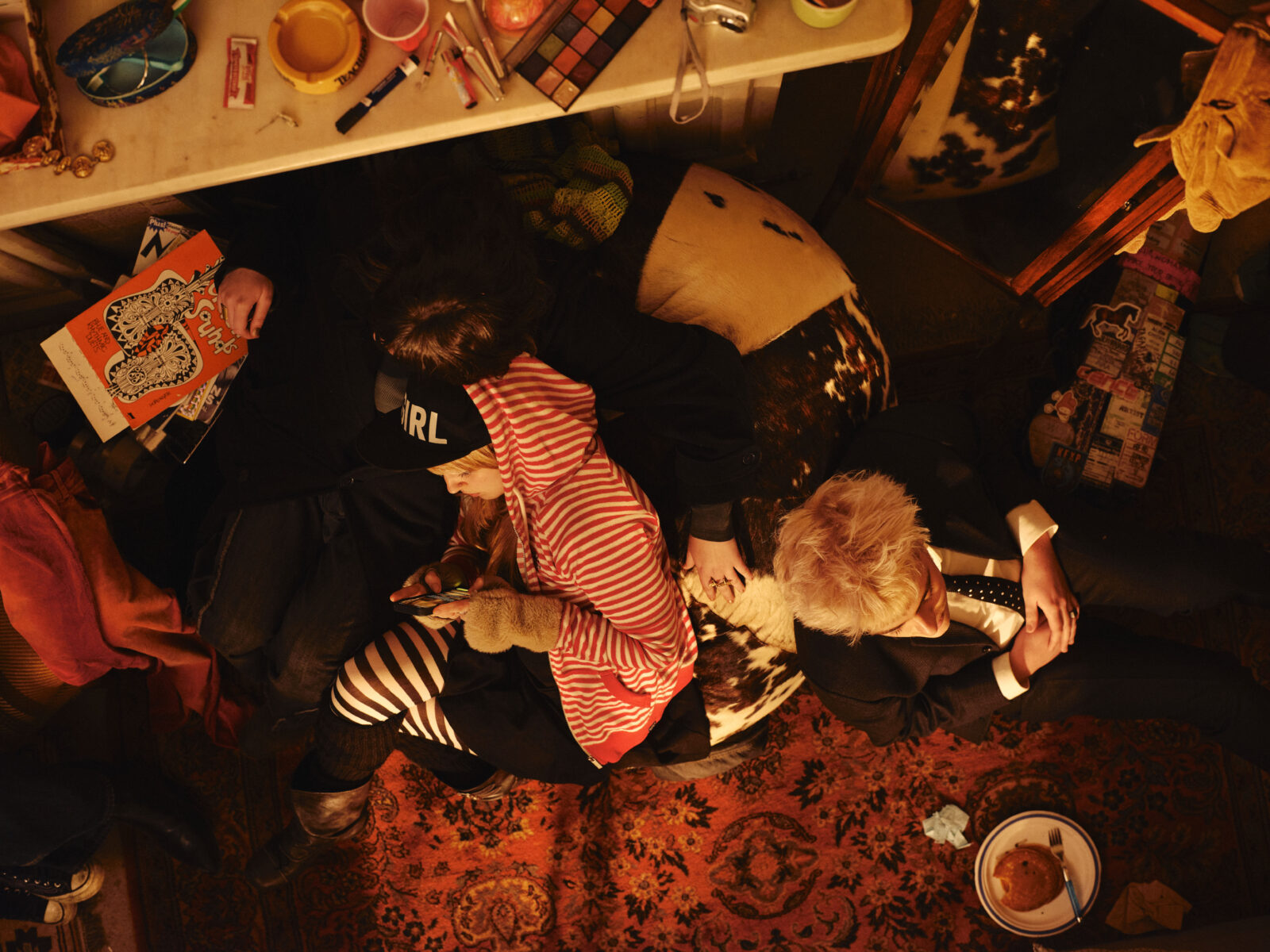
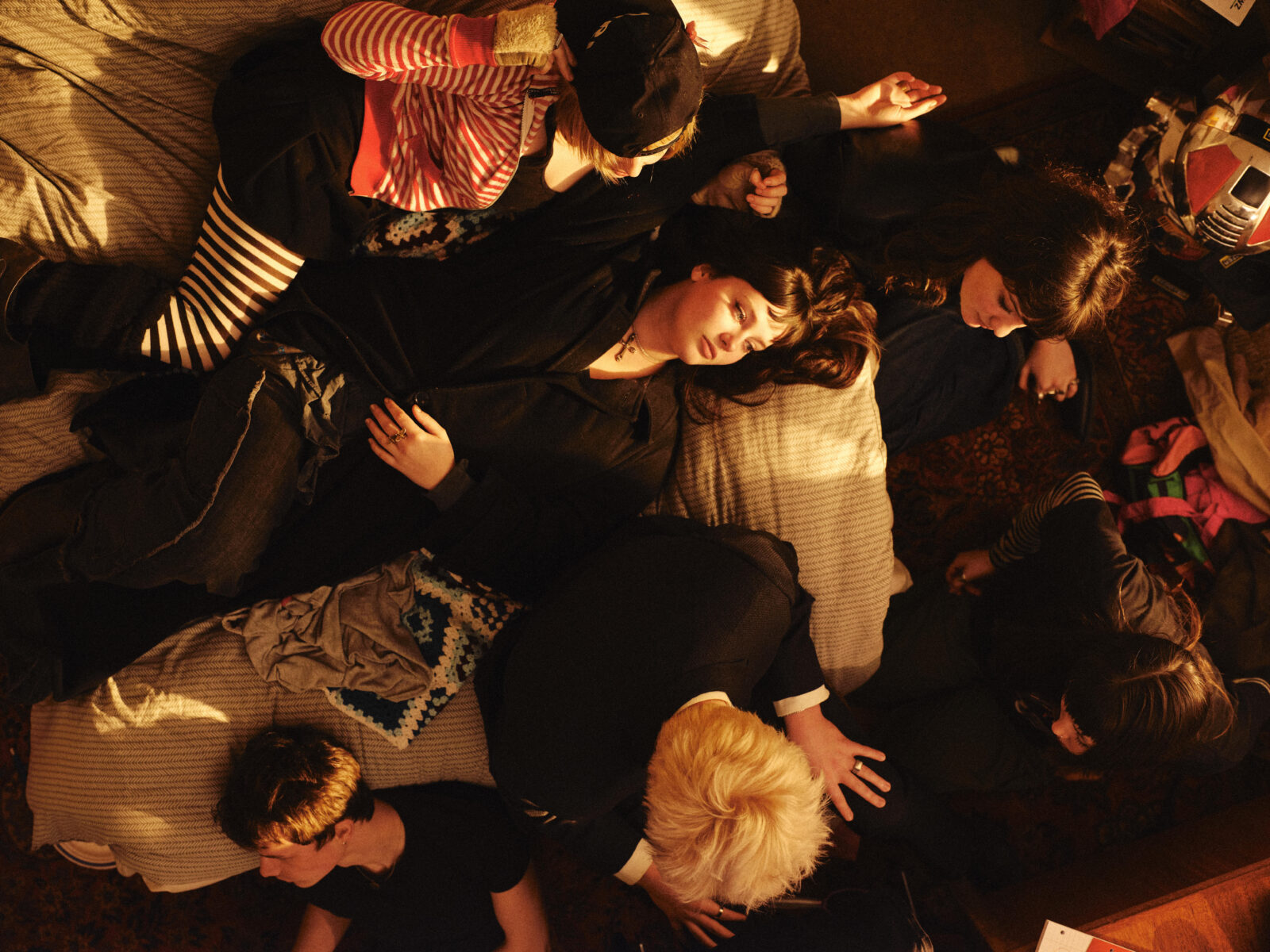
The assertive “Get Up and Dance” sees synthesist Emmie-Mae Avery step up on lead vocals. Coming from a classical background, her “identity as a musician and a person has changed so much through being in this band,” violinist Clio Starwood says. Making the switch from bass to guitar as the last to join Man/Woman/Chainsaw, Billy Doyle has got over his imposter syndrome: “I made this one guitar loop at the end of ‘Something Else to Give’, it’s a locked groove on the vinyl.” “All of us in the studio recorded a gang vocal; it’s the first time we’ve done it,” Avery shares. “It fills some of the songs out in a really cool way that we’ve not done before, kind of like a choir.”
At the crux of Cannonball is an old North London vicarage converted into a creative space for musicians and artists alike, even making room for a pottery studio downstairs. It served its crucial purpose as a place for the band to write and rehearse in as teens. Ironically, singer-guitarist Billy Ward – the only absentee – happens to be the portal to such a stomping ground, as it’s the exact location where his parents met. “We also had a neighbour who didn’t like us,” Leppänen laughs. “She kept calling our music ‘a racket’, and I was like, ‘That’s subjective, this is music.’”
Despite the complaints, the vicarage is intrinsic to Cannonball‘s identity. “We didn’t really want to necessarily do it in the vicarage,” Cherry says of the album cover. “But it was a free space that we had access to, and now that we’re not there anymore, it’s a nice way to remember being there.” The busy artwork depicts a fake bedroom setup, carefully assembled with personal knick-knacks as easter eggs referencing a different song on the record. “We were like, ‘Let’s just have someone cannonballing in the room,’” Cherry remembers. “We did break straight through the bed.”
That someone was Cherry herself, personifying the album title ripped straight from a standout lyric in the single “Nosedive”. As Avery puts it, “cannonballing into the music industry.” “Splash!” Starwood interrupts. “Bang!” Through the metaphor of a broken bird wing, “Nosedive” stresses longing for comfort and freedom in a relationship. For its visual, a tonal shift into the danceable and upbeat is brilliantly depicted with a closing celebration – the strobe setting is none other than the vicarage bedroom.
“It was kind of a miracle how it came together,” Avery says. During one of their seaside retreats, the band split into two groups, neither trio realising they were accidentally writing different halves of the same song. “We played ‘Nosedive’ for the first time in front of people like five days before it came out,” Doyle says. “So we had no clue if people were going to like it or not.” Starwood smiles, “They did. That song was a really nice surprise.”
For every fan and every detractor, Cannonball arrives after much anticipation at the good place. Their younger selves might never have imagined it, perhaps neither their current versions, with eyes already set much further afield for “Japan”, “South America”, “Helsinki”. “We haven’t really set a specific goal,” Cherry says. “We just want to keep making music, if it’s feasible to keep doing it and keep enjoying it.” It’s an achievement that a statement as big as Cannonball has not jaded Man/Woman/Chainsaw, the indie rock success story. Conversing with the band does not indicate they are chasing expectations. Strip away the promo sheen, and they are six lifelong friends coming into themselves, trusting the process, and one another. “Younger me might think, ‘What the hell, you sold out, man,’” Doyle remarks. “But me now… I think it’s great.”
Listen the album…
Words – Douglas Jardim
Photography – Charlie & Charlie


