What does it mean to be a pop star? For Canadian dreamer Sophia Stel, it means anything she wants it to. As she signs to A24 Music and finishes work on her debut album, the 27-year-old remains – above all – defiantly herself.
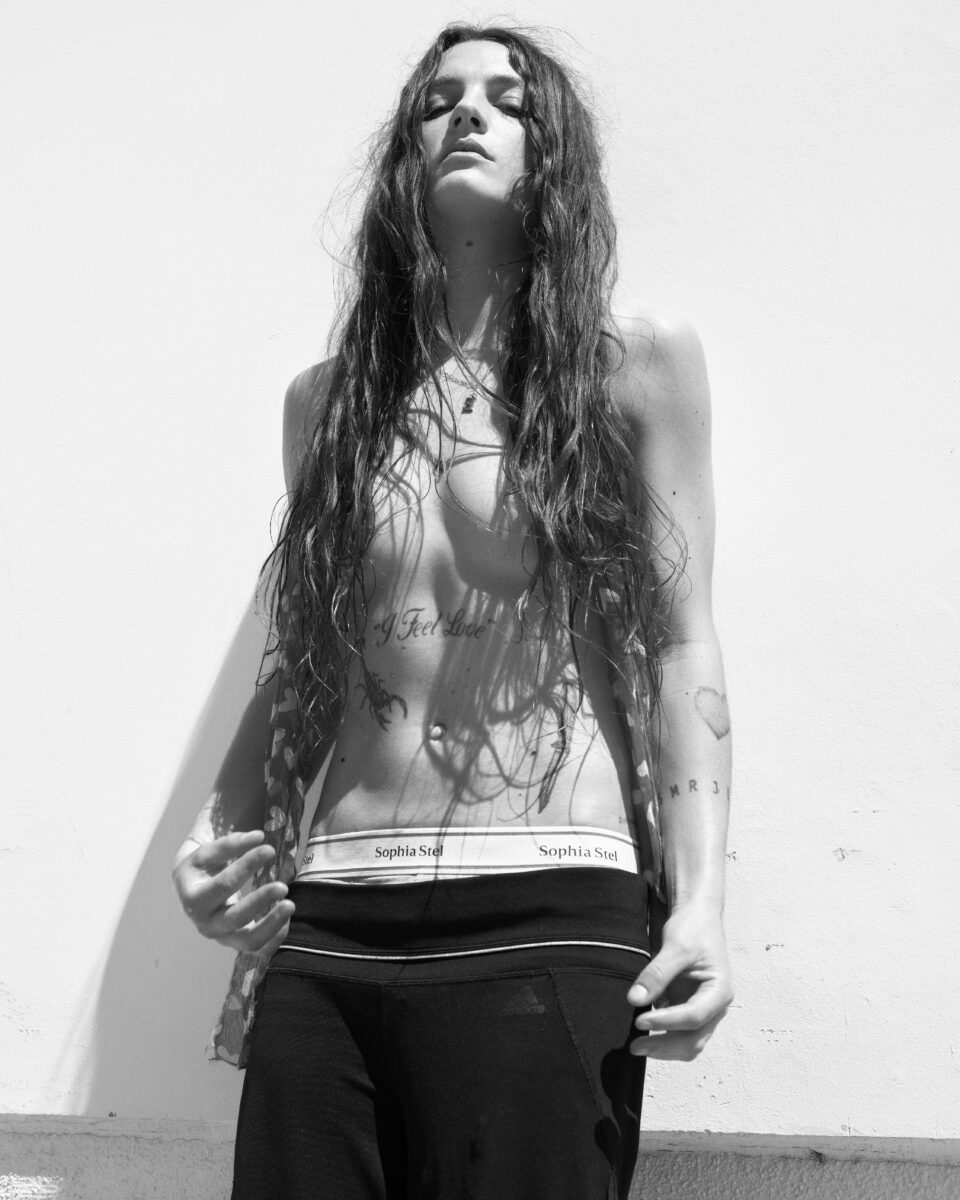
In barely the time that it takes for the Earth to orbit the Sun, Sophia Stel has had a breakthrough sophomore EP in “How To Win At Solitaire”; walked for Ann Demeulemeester; modelled for Palace; become A24’s music label’s second artist signing after British singer-songwriter mark william lewis; opened at pop royalty Lorde’s duo of LA arena shows. So, she must be feeling a little bit like a wildcard? A wrecking ball? Something beautiful? “Some days for sure,” she giggles. “I’m like – ‘I rock.’”
As we speak, it’s morning time for the Canadian. Hoodie on, her first cigarette of the day (one can only assume) dances nonchalantly from her fingers to her lips and back again. “But I don’t know,” she continues with a delicate flash of doubt. Her voice is slightly hoarse, the endings of her sentences more breathy than the beginnings. “Things are fast, and I take quite a long time to process. There’s an element to all of this that feels a bit like a dream.”
While her rise to fame at times feels lucid, the 27-year-old’s insatiable sense of self never sleeps. Her musical approach and artistic philosophy are rooted in a distinct snapshot of authenticity – an idiomatic incarnation of what a pop star today looks and sounds like. She writes, records and produces everything herself, mostly in her bedroom. She shoots her own gorgeously grainy videos alongside her best friends, and edits them alone, “to honestly a painful level.”
She’s unafraid of imperfection. And pop music dazzles most when it’s messy. Sophia – like the “inspiring” Miley – gets that. “There was a lot of trying to understand myself, how I could fit into that world,” she meditates, present yet vacant, a tidal wave of thought swimming behind a cool set of dark, curious eyes. “I wanted to be a pop star, but I had to find a way to build my own world and reflect the world that I live in. Because to do it any other way would start to feel really far away from myself.”
So who is Sophia Stel? She is the icy invasion of deep-seated emotion, and the serene glimmer of impervious immersion. She is hauntingly opaque vocals and ethereal, masquerading synths, tucked between fuzzy mixes and fey atmosphere. She is love that’s lost, and she is love that’s gained.
She’s Vancouver’s spark; a dense and creative Canadian West Coast hub where she settled in five or so years ago to be with her now ex-girlfriend. She relocated from her childhood city, the secluded, craggy capital of British Columbia, Victoria, where she was raised in a religious household with barely enough fingers on her hands to count her smorgasbord of siblings.
Her new home is where she found freedom to be herself and opportunity to succeed – a resting ground that she never wants to fully leave again. “It is tempting to go other places, but I think it’s best to stay,” she avows. “For myself and my own identity as an artist, but also for my own health as a person. I live with my brothers and my best friend, and my other best friends live downstairs. And we just hang out and smoke and talk about things. I walk out my front door, and I see more of my friends.”
“Artists shouldn’t feel this need to chase something,” she smiles knowingly. “Let it come to you.”
Music has always been intrinsic to Sophia. From making trap beats in her bedroom as a teenager to finding an esoteric and genre-agnostic production identity; to internally mapping lyrics along with the diverse dance music that pumped from the speakers during her eight-hour night shifts at Vancouver club Paradise (now Paradise Cultural Society), where she would erect and dismantle a makeshift studio to record her own songs during the venue’s closing hours.
In the beautiful but challenging isolation of Victoria, and through her intimate community of Vancouver, the foundations of Sophia Stel, the artisté, were born. “I make what I want to hear first of all,” she proposes. “And then try to make things that reflect my current life as much as possible. Those have been two things that really anchor all my writing as well as my production.”
It’s a base-level ideology that’s stood her in good stead. Rather than being sucked into the sonic status quo that drives the bustling cities where stardom feels only just out of reach, she stared straight into the darkness of an impossible dream and found light despite its rarity. “I was talking to somebody about this. In LA, for instance, there feels like a pretty clear path of like, ‘Oh, this could happen for you in this way.’ So it’s in your mind, this idea about trying to make things or do things in a certain way to create momentum. Here [in Vancouver], a lot of the time, the best-case scenario is that your friends will really like it. So you make stuff that you hope the people directly around you will like, or you make stuff for yourself because there isn’t really much promise of it going anywhere else. I think that’s been a really positive thing for me with my music. That’s why I continue to work at home mostly.”
There has been no industry shortcut or head start for Sophia. She’s worked various odd jobs, carried boxes in warehouses, painted houses, and survived night shifts at clubs. There has been no silver spoon. No unlocked door. Yet she found a way to open it; rather than bang it down, she slithered through the back entrance.
Her September 2024 debut EP “Object Permanence” – all patchwork synths, grainy electro tinges and earnest heartbreak – cultivated a once-niche alternative pop-adjacent style that was quickly becoming mainstream. By the time its maturer, denser, more cinematic follow-up project, “How To Win At Solitaire”, came along 12 months later, Sophia was critically appreciated by the old guard, among the buzziest names in the online stratosphere, and on the climb to pop culture folklore.
Last summer, before the release of her sophomore EP, Sophia was “talking to a lot of labels,” she recalls. “I had decided I wanted to sign in general because I needed the support.” But there was one – a new scene-shifting disruptor swimming against a sea of majors – that stood out.“
For a lot of reasons,” is why she signed with A24 – officially in late February –becoming only the second artist on the musical imprint of the film distribution mainstay, joining London’s idiosyncratic folk singer-songwriter mark william lewis on the roster. “They’re cool as a company, and want to make interesting stuff. It’s how they’ve built the movie company, and with the label side of things, they want to do something similar, while finding artists that want to grow alongside them. There’s a lot of pressure on artists to grow extremely fast. I’ve been making music for a very long time, and for me, it’s always been something that I need to take my time on and make sure that things feel right in order to feel comfortable. I want to work with people who will take that time with me.”
Sophia’s first step with A24 will be her biggest stride so far: her debut album. It’s still very much under wraps for now, but she discloses that the body of work is in its “final steps”. A first full-length LP is the most quintessential moment of any artist’s career, and there’s bound to be the temptation to switch out processes that have dictated earlier success, to mould your vision into what you’re told or what you observe that listeners and the industry expect. But in her record’s construction, Sophia, bold and unyielding, has been rigid – to herself, and to her creative maxims.
“I wanted to keep a lot of things the same,” she says on finding her flow to write the album. “I’ve mostly made it in Vancouver, as well as some stuff on the road. But if I’m working on the road, I’m working in my hotel room versus a studio. Making this record is my first time releasing music to an actively larger number of listeners – that is a huge change in itself. But I’ve tried really hard to keep that out of my head as much as possible, because I want to make sure that I stay true to the way I’ve always made music. It’s about trying to figure out what people want to hear from me versus figuring out what I want to hear and doing that. Trying to keep my head in the right place.”
The forthcoming record will invariably take her to newfound fame and standing. Her life, too, will inevitably be different. But Sophia Stel won’t ever change. She’ll still be working with her best friends, making music out of her bedroom, editing every last frame of her videos. Why? Well, “because honestly it’s just too fun for me,” the dreamer grins exquisitely. And isn’t that what it’s all about?
WONDERLAND SUMMER 2026. GUEST EDITED BY MILEY CYRUS. SHOP NOW.
Photography Mario Sorrenti
Chief Creative Officer & Styling Alastair McKimm
Words Ben Tibbits
Hair Bob Recine
Make-up Diane Kendal
Set Design Philipp Haemmerle
Executive Producer Dana Brockman
Producer Max Bonbrest
Casting Alexandra Antonova for Samuel Ellis Scheinman
Lighting Technician Lars Beaulieu
1st Photo Assistant Kotaro Kawashima
Photo Assistants Paolo Afante, Kurt Mangum
Digital Tech Charles Meyer
Fashion Assistants Taylor Wood, Kassidy Taylor
Hair Assistant Jeelan Aleem
Make-up Assistants Eduardo Jiminez, Breanna Harmon
Set Assistants Oscar Haemmerle, Xavier Mozejewski
Production Assistant Din Morris