As an imaginative kid, genre-defying experimental artist Jean Dawson would lose himself in the school library. Now five albums in, with an undefined new project in the works, the 30-year-old’s discography has become a story all its own.
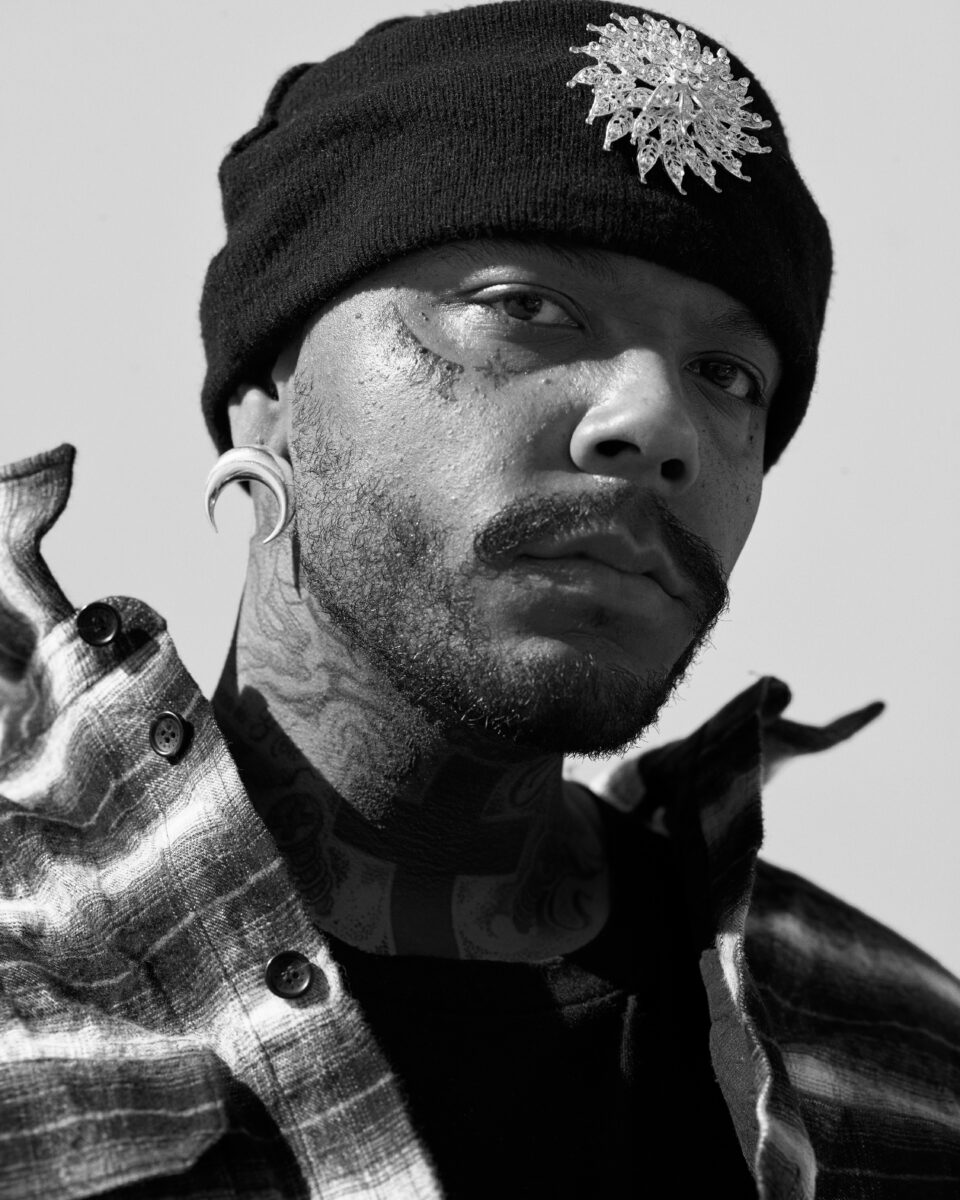
Tijuana-raised Jean Dawson was 14 years old when he got his first tattoo. “I’m pretty sure the dude was fresh out of jail because his home was like prison decor,” the 30-year-old artist laughs. Still, Jean had his mother’s permission. Sort of. “Mom wasn’t okay with tattoos, but she knew that if I wanted to do something, I was gonna do it,” he says.
16 years later, the black ink on his forearm still reads pain passes, but beauty remains.“ I don’t know what I was thinking with that sentiment, but I know when I got it, I was like, ‘Yeah, this is my life,’” he shares. Mind you, he doesn’t actually enjoy getting tattooed. “My pain tolerance sucks. I don’t like hurting for extended periods of time…But also, like, I love the art,” he shrugs.
It’s hard not to see the tattoo as an accidental mission statement. Across a discography spanning eight years, with standalone singles scattered throughout, there’s a grit that runs through Jean’s music. Much of it traces the darker contours of his life: struggles with mental health, a youth spent in troublesome company, experimentation with substances, and periods of self-harm. Music became a form of escape, steering him away from danger and towards something more restorative. In interrogating those experiences, he found a way to reinterpret beauty. Jean likens his production process to a form of artistic defacement, disrupting perfection to make it feel more human. “I’m putting curse words on things that don’t need it, and graffiti on things that are supposed to be beautiful. I guess that’s the pain passing on to beauty,” he says.
So rather than dwell in the darkness, Jean makes sublimity from ashes. His voice moulds itself to whichever musical terrain he chooses to explore: disco, rock, indie, folk and hip-hop all coexist within his catalogue. Falsetto? He reaches for it with ease. More often, though, it’s that buttery, velvety timbre that anchors his songs, brightening and darkening in step with their themes, whether charting romance, androgyny, mental health or childhood. On paper, such stylistic breadth could sound unruly. In Jean’s hands, every beat, melody and reference point feels remarkably cohesive. The range is evident across standout tracks such as “Devilish” from his 2020 debut Pixel Bath, “DARLIN’” and “Houston” from 2024’s album, Glimmer of God, and most recently on last November’s compilation Rock A Bye Baby, Glimmer of God. The latter, in particular, reveals an almost archaeological approach to music-making, excavating sounds, genres and influences before reassembling them into something distinctly his own.
With legacy artists such as Prince and Michael Jackson among his inspirations, alongside the hum of funk outfit Zapp (and its frontman Roger Troutman) and the swagger of G-funk icon Snoop Dogg – absorbed through his parents’ record collection – Jean has built his life around an expansive study of music. Nothing is off limits, though pop remains his mitochondria. “Pop music morphs with the time that it’s in. It’s one of the only genres that’s truly genreless. So you can go from pop music being Britney Spears to Post Malone and Miley Cyrus – ultimately the through line is that it’s popular, but the sound of pop music doesn’t necessarily exist.” That fluid definition explains his comfort in a sonic no-man’s-land: he moves freely across it all.
Jean’s musical epiphany came at 13, while he was still in middle school. His mother, originally from Mexico, worked as a secretary, while his father, a California-born African-American and military man, helped raise the family on modest means where “opulence” wasn’t the norm. Together, they saved enough to buy him his first Yamaha acoustic guitar. “I played it until my fingers would bleed,” he recalls. “From a young age, I knew that I wanted to make music; I just didn’t have the means to do it.”
In the evenings, after a day of ninth-grade shenanigans, he would spend time at a nearby Guitar Centre, experimenting on the keyboards. His visits became so frequent that staff began bringing him sodas while he practised. “I don’t think they understand that they perpetuated my life and my music career,” he says, reflecting on the employees who allowed him access to a space he might not otherwise have had. “A lot of the people who work at these music stores are musicians most of the time. Instead of making it an issue, they’re like, ‘He just likes music, it’s okay.’”
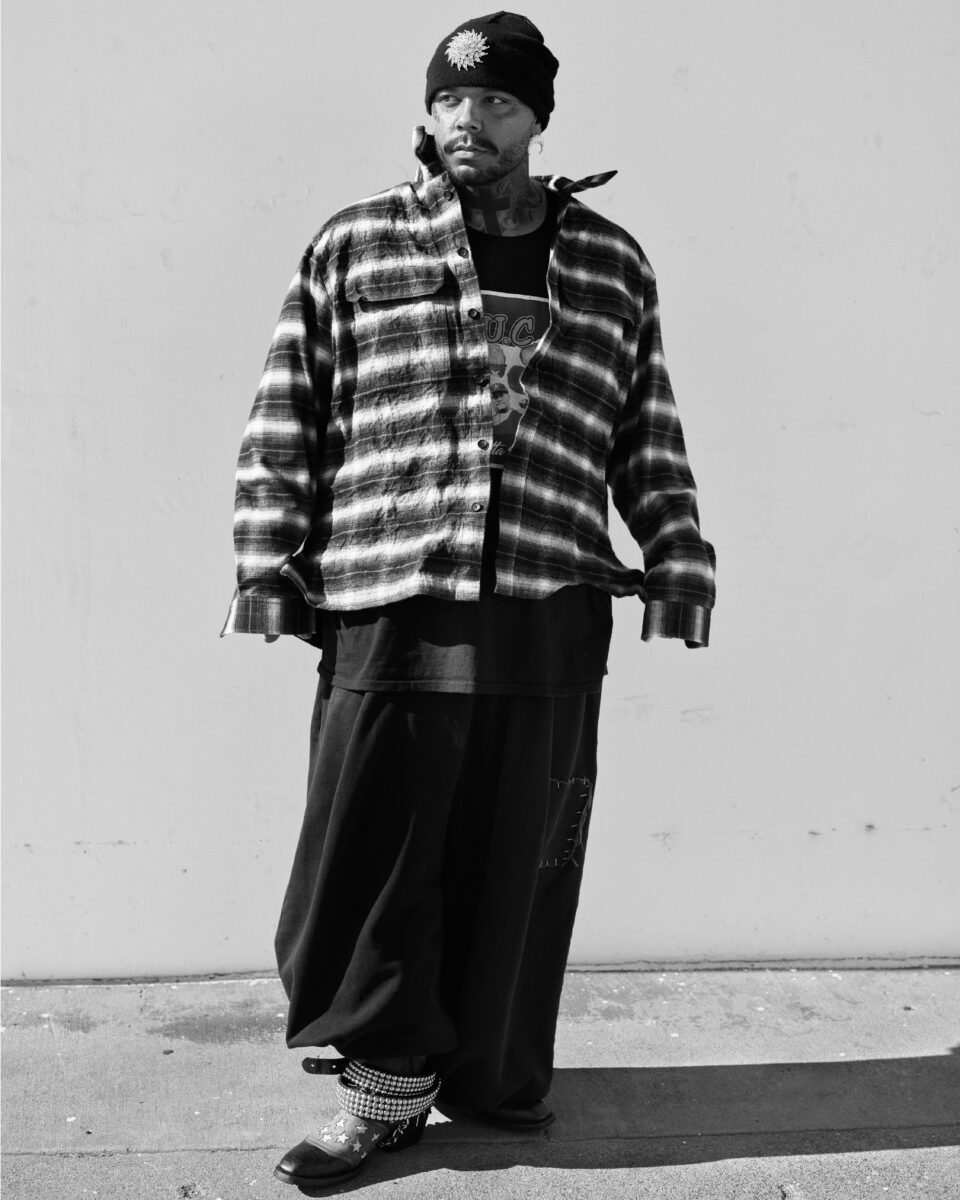
Even with the helping hand from those somewhat grassroots “magicians”, as Jean puts it, music wasn’t always a wave he rode solo. Once his best friend and library companion, Marion, joined in, the duo became inseparable. “We started recording music every weekend, and every time we had days off school. I worked on three, four mixtapes and a bunch of other stuff – that was the beginning.” Those early recordings were disjointed by design, melodies that began softly before erupting into punk-inflected crescendos. They were his first attempt to reconcile the sounds that had shaped him, from funk-fused hip-hop and old-school soul with a gospel undertone to the virtuosic pop of the ‘90s. In effect, it became voluntary homework in self-definition, long before he adopted his 2019 moniker, Jean Dawson.
Despite middle school ruthlessness and Jean’s reluctant participation, he still carved out space for self-discovery. “I didn’t go to school dances, and I missed out on a lot of things because I was heady as a kid, but being in the library was a special thing for me and Marion,” he shares. “I think about that kid a lot. He’s definitely still very present within myself, and takes the driver’s seat a lot of the time, to the point that it kind of throws me off.”
He never anticipated that presence would continue to shape so much of his life and creative output. Today, he’s a Grammy Award-winning artist, recognised for his production and arrangement work on Beyoncé’sCowboy Carter. Also under his spike-studded belt are songs with artists A$AP Rocky, Lil Yachty and SZA, summers spent touring with Linkin Pink and co-signs from Sir Elton John himself.
Even among that already impressive list of musical peers, Miley Cyrus occupies a place of her own. Though the two have never met, Jean’s admiration runs deep. Did it begin as a crush? Maybe. “Had I been 11 years old when she was, you might have had some issues with me,” he laughs. And of course, there’s the music. But what fascinates him most is the way she has navigated a life lived almost entirely in the public eye, embracing a spotlight that never seems to dim.
“My first understanding of fame was watching Hannah Montana,” he says, before launching into a 42-second meditation on celebrity, identity and self-mythology. “I’m in awe of somebody who can navigate being successful for fucking ever, and not lose their mind. To be perceived by people who don’t understand you – none of it is natural. It is just this thing that we’ve manufactured; our own personalities to sell something, and nine times out of 10, what we’re selling is an after-image of what we were trying to become. By the time it’s selling, you’re like, ‘I’m not even that anymore’, but you have to continue, and thenyou’re cosplaying yourself – which goes back to Hannah Montana.”
From there, the fandom only deepens. He reels off the many incarnations of Miley Cyrus with the enthusiasm of a lifelong devotee: “Miley Cyrus the rapper – with the Jordans”, or, Bangerz-era Miley, and, perhaps most importantly, the “Party in the U.S.A.” years. “I don’t remember a time when Miley Cyrus was not around in some capacity,” he says. “But what I perceive her to be doing now looks like freedom.”
At 19, with the release of his first mixtape, “Bad Sports”, Jean also found himself reckoning with a truth that felt oddly liberating. “The only true ordeal in our life is death. There’s no solution to it, nor does there need to be.”
Making peace with that idea meant learning to stop treating every uncertainty as a problem to be solved. He arrived at the principle of Occam’s Razor: the simplest explanation is usually the best one. In practice, that often meant allowing his 13-year-old self who “had all these ideas and imagination” to guide the artist he would become.
“Now, I’m expressing [that creative freedom] in a way that allows me to do it all, and there’s no reason I can’t,” he says of a forthcoming body of work that remains deliberately undefined. “The songs I’ve been making tug at my own heartstrings. It’s a little self-indulgent, but I need this right now – to make stuff that feels very familiar to who I have been, what I learned from and how I learned from it.”
The sentiment echoes the lesson behind his first tattoo. In pursuit of something lasting, he has learned to embrace the discomfort of beauty that resists neat definition or containment. “I don’t know if it’s an album yet…I don’t know what it is,” he tells me. “All I know is that it’s honest.”
WONDERLAND SUMMER 2026. GUEST EDITED BY MILEY CYRUS. SHOP NOW.
Photography Mario Sorrenti
Chief Creative Officer & Styling Alastair McKimm
Words Aswan Magumbe
Hair Bob Recine
Make-up Diane Kendal
Set Design Philipp Haemmerle
Executive Producer Dana Brockman
Producer Max Bonbrest
Casting Alexandra Antonova for Samuel Ellis Scheinman
Lighting Technician Lars Beaulieu
1st Photo Assistant Kotaro Kawashima
Photo Assistants Paolo Afante, Kurt Mangum
Digital Tech Charles Meyer
Fashion Assistants Taylor Wood, Kassidy Taylor
Hair Assistant Jeelan Aleem
Make-up Assistants Eduardo Jiminez, Breanna Harmon
Set Assistants Oscar Haemmerle, Xavier Mozejewski
Production Assistant Din Morris