Reckoning with grief and generational trauma for her devastating third feature film, French auteur Julia Ducournau tells writer Douglas Jardim about sacred material, choreographing a climax, and growing up during the peak of the AIDS crisis.

It’s been a major year for body horror enthusiasts. Set aside The Substance at the Oscars, a serendipitous feat in and of itself, we’ve seen a myriad of movies attempt to get under our skin through some of the most grim and grotesque showings in recent memory. Maestro David Cronenberg’s The Shrouds. Norway’s The Ugly Stepsister. Together with Dave Franco and Alison Brie.
At 41 years old, French director and screenwriter Julia Ducournau, by chance, has become intrinsically linked to the term ‘body horror’. She is one of genre film’s most daring contemporaries, brave enough to tackle the vulnerable transformation of the (often teenage) body in her graphic oeuvre. Her fascination for flesh stems from her upbringing, both her parents are doctors. At the same time, she delivers blow after powerful blow in searing examinations of relationship dysfunctions and dissolves.
In the transgressive spirit of her New French Extremity predecessors, Ducournau has provoked plenty of conversation and continues to query any sense of contentment with the cinema status quo. Her historic Palme d’Or win for 2021’s Titane is proof of this. Who could have foreseen that the first female director to receive this reputable award since Jane Campion in 1993 would find good fortune with shocking strong violence and women-on-car sex? Five years before, paramedics were called to a TIFF screening of Ducournau’s debut Raw. Too realistic of a depiction of bite marks, gaping wounds, and lacerations, for a couple of fainting patrons.
Amid the noise in new body horror film canon sits Alpha, released in UK cinemas today (Friday 14th November). Ducournau’s third feature, it stars young Mélissa Boros in the titular lead role of a 13-year-old who, much to the dismay of her single mother (Golshifteh Farahani), returns home from school with a tattoo on her arm. Exhibiting haunting parallels to the lived, inspired AIDS crisis, set between the 80s and 90s, Alpha’s already unrelenting coming-of-age is amplified by the impending doom of a fictitious bloodborne pandemic decimating the population of her dismal world.
Lightly surrealist by design, Ducournau’s latest vision grows rampant with moral panic and social stigma. It serves as an agonising reminder of the negative biases that persist against those battling a life-threatening disease. Alpha’s estranged uncle Amin: a sobering treatment of intravenous drug users (IDUs). Pushing himself to relatability, César Award winner Tahar Rahim lost 20 kilos (44 pounds) for the part. To label Ducournau as simply a body horror director would be to diminish the value of her unflinching storytelling credentials beyond the gory details. At its core, this is another family drama, three for three with Titane and Raw. The most fraught of love triangles.
Yes, Alpha is bloody and painful like a body horror, but it does not desecrate the sanctity of the anatomical, unlike a lot of model examples. Rather, it preserves it, in the divine marble makeup of the infected. In preparation for Alpha’s Cannes premiere, which was met with mixed results in May, distributors described the film as Ducournau’s ”most personal, profound” work to date. “I want to say that it’s a big joke every time, I’m not the one who said that that was my most personal film,” she is quick to preface. “That’s their take on it, I’m glad they think so.”
Our conversation takes place on a mild Monday morning, cigarette in hand and cooler than ever, Ducournau and I quickly bond over a mutual appreciation of Girls on Tops. The frenzy of the 69th BFI London Film Festival is behind us. Reserving some time in the middle of a positively busy schedule, she is eager to discuss Alpha with Wonderland – delving into its truths, its talent, and the emotional intricacies of her filmmaking.
I absolutely adore the film, and I can’t wait to see it again on the big screen. For audiences going into Alpha for the first time, would it be remiss to take the word of distributors over your own?
I really believe that filmmaking is a continuous movement, and that hopefully people will think the same about my fourth one, my fifth one, and so on. For me, it’s always about getting more personal, more sincere. Getting closer to what I actually want, the emotions I want to convey. It will always get more and more personal, I believe.
How did you approach balancing personal real-world references pertaining to the AIDS pandemic with fictional elements?
A lot of people say it’s a movie about AIDS, which I think is not exactly accurate. If it had been a movie about AIDS, I would have named it AIDS, and I would have portrayed AIDS as it was, and probably in a very precisely historical way.
I think that it’s really about the shift that I did. To me, the virus that I wanted to expose in the film is fear itself, and the way fear seeps into a society. How it creates taboos, how it generates rejection and hate. From the moment that no reparation is made, from the moment where no one actually wants to embrace. A contact pandemic, in that situation, that concerns everyone, and keeps pointing at people and shaming certain people in order to cope with the fear. It can only induce a ripple effect, and the trickle-down effect that generates more and more trauma within a family or within an entire generation, and through the next generations.
However, with the peak of the AIDS pandemic in the 90s, the peril that is clear in my film is precisely through the way society reacts to the virus. That definitely stems from my memories from childhood, also from the conversations which I had with people who were actually adults or young adults at the time.
Did you consult with any particular experts or communities when researching for the film?
I researched and interviewed people who were at the base of the founding of ACT UP, in New York, who were in the front row for the start of activism for the LGBT community, and also protecting IDUs the same way. Everyone was in the same boat because they were the ones that were stigmatised by an entire world. In my memories, it was an extremely bleak time. I definitely remember it as a period of extreme homophobia, extreme xenophobia, extreme misogyny as well, as far as sex was concerned.
Looking back, how did that environment shape your understanding of fear and desire, in relation to sex and bodies?
That basically all of us, people who were considered minorities at the time – homosexuals, IDUs, women, people of colour – as far as sex was concerned, we could only do wrong. It felt like, coming from us, sex could only be a taboo, could only be dangerous, could only be a wrongdoing in some way. My parents being boomers, they always told me about freedom of sexuality in the 70s, which also generated, I think, a genuine thinking of gender equality at the time through the freedom of sexuality that they bided by.
When you think of the drawback that there was as far as this is concerned, in less than 20 years, it’s crazy how fast things can just go back to a dark age in moral ways, in ethical ways, and in a human way, when fear and brutal circumstances happen in a society. As far as we’re talking about a body, a family or an entire society, as long as we keep the taboo and we don’t process it, as long as we are denied our capacity to grieve, it can only go on.
One of the most striking visual metaphors in the film is the metamorphosis of bodies, infected by the mysterious disease, into cracked stone. How did you conceive that iconography?
It was very clear from the get-go. To me, the idea was to use marble, which is a sacred and noble material that is used to depict saints. The references that I gave my makeup artist and CGI for the marble bodies were recumbent effigies from cathedrals and churches I had been to and taken pictures of. Then we had to decide what colour of marble, what colour of veins in the marble, what level of crevices?
What meaning did you want the marble bodies to convey?
I wanted to somehow implement some sacredness to the people who have been treated like pariahs by society, and I wanted to use it for them in order to sanctify their lives and their deaths. To somehow create an eternal monument that is sacred, that gives them the verticality that they have been denied through their entire lives and death. So to me, the choice of marble was actually quite instant. That’s exactly how I wanted us to see them in the end, as martyrs or saints, definitely.
I’m interested in how you came up with the concept of the red wind. This post-apocalyptic force of nature that is meant to represent the virus in your film, it’s quite an arresting image.
As far as the red wind is concerned, well, I didn’t have that many references, really. Obviously, everyone thinks Dune, but I wanted something that was more realistic than this. Just for the simple reason that the idea of the red wind, to me, is very logical. In the biopsy scene, when [Amin’s] back starts crumbling, within it, the blood has petrified as well. The dust that we see protruding from the back is red. I did not want to make it white; otherwise, it would have been too distant. It would have made him a statue already, when I wanted to keep it at the human level. It still had to look like blood, but blood in a mineral way.
The red wind is made of the red dust of the bodies of all the ones that we have lost through this pandemic. The first time we go to [Alpha’s grandparents’] council estate, there is red dust on the floor. In my memories of the council estate where my grandparents used to live, there was red dust on the floor as well, it was not concrete.
For the look of the last red wind tempest, I wanted the wind to feel extremely real and to feel the dust, the particles of dust, to be very gritty and organic, not smooth, like we were on Mars. The red dust is real, there is nothing dreamlike about it. Everything in the creation of this tempest comes from real aspects of the movie.
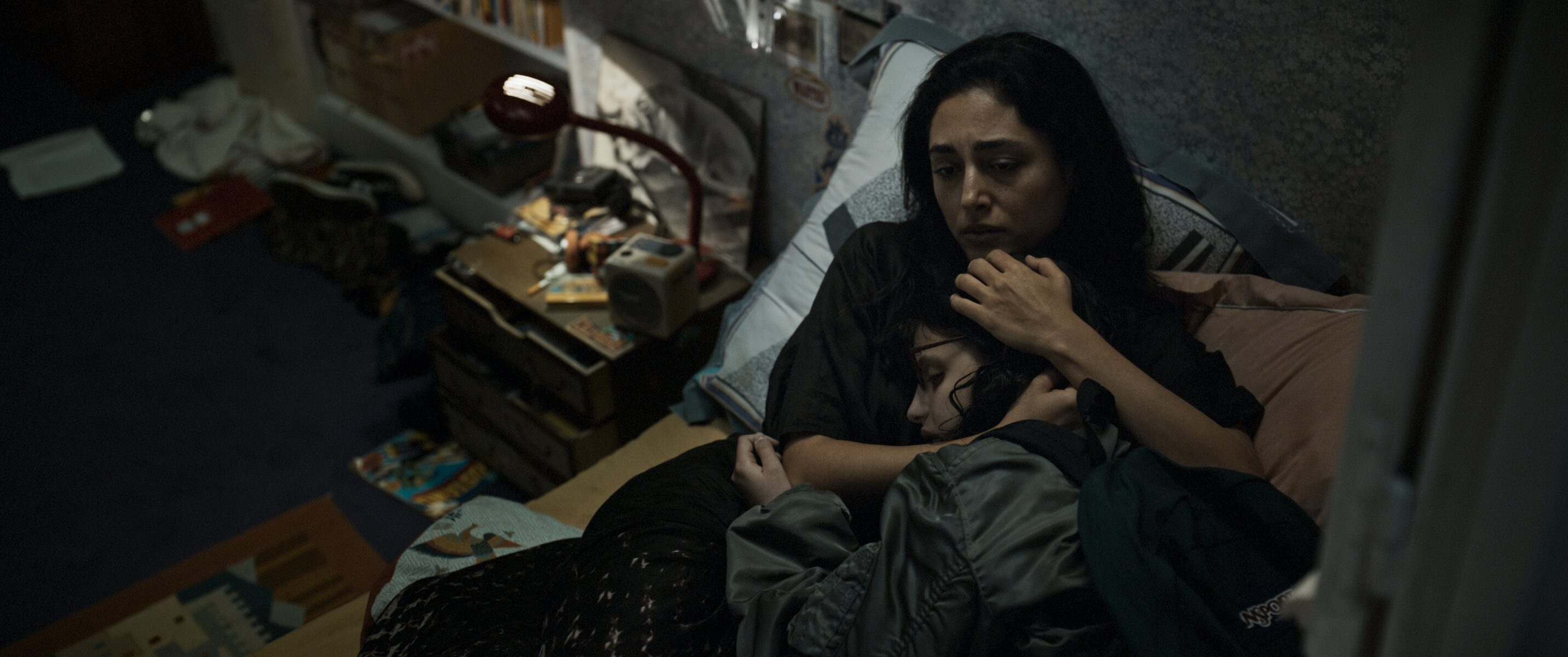
Alpha’s complicated relationship with her mother and uncle is, truly, the heart and soul of the film. How did you develop the emotional architecture for those hard-hitting scenes?
It’s easier to direct with five hundred people, extras, a crane and a gimbal like I did in Titane, in the car show. The technical aspect is incredibly difficult, we had the entire day to rehearse it, and at one point, it’s not really character driven. It’s really about a method to make the most flawless movement. I think that the technical aspect creates a form of emotional distance, it’s way harder to question your distance to the situation, and how to gauge it, when it’s really a scene in a room with people being raw, naked, honest and emotionally on edge together.
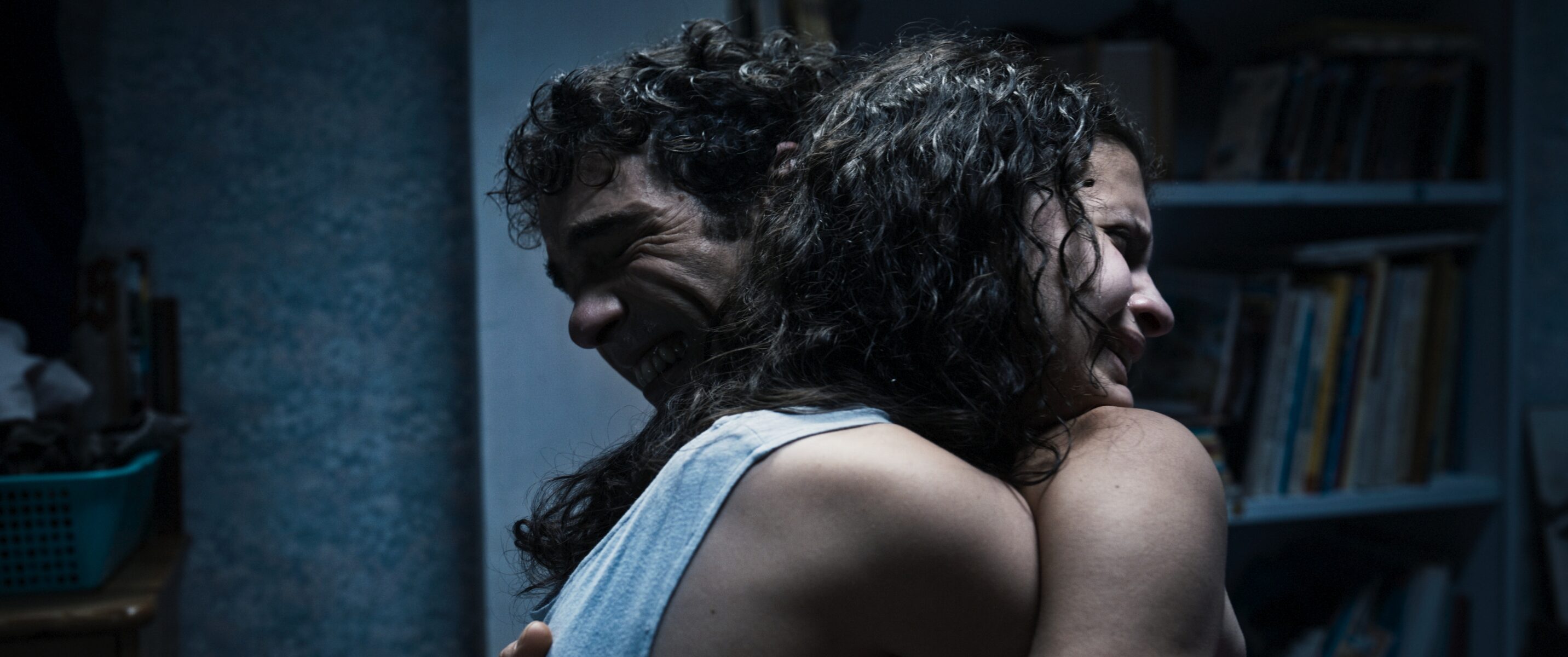
The scene in the hotel, and when Alpha and Amin embrace and cry together, are a little bit of the same human questioning, in a way. Both scenes are very different, one is extremely talkative, the other is almost completely without dialogue. As a director, it was always about questioning the right distance of the camera, questioning the lens, the camera angles. Not wanting to overbear on the emotion. But at the same time, wanting to make the exact build up to that moment where you’re going to strike that perfect note within both your actors and your characters at the same time. It’s very intense.
Did you find yourself guiding the brilliant Mélissa Boros through any moments of discomfort on set? I can imagine for a newcomer carrying a story as heavy as this, it was no easy feat.
I knew that the scene with Amin and Alpha embracing and crying was not going to be a problem for Tahar. He is a very accomplished actor. This was in the middle of the shoot, so I knew what to tell him. Very simple words, small things, sometimes silences, for him to get deep into himself and produce the emotion, take after take. It was very different for Mélissa, not having the experience on set that Tahar has, and being younger also, that was a scene that she was very scared of – not performing the tears right. I understood that, and we talked about it together.
I was hidden in a part of the set that was very close to them. I didn’t want her to feel alone in this, and the tension was really palpable on set for everybody, so I wanted to be next to her. We played the game of action/cut, knowing that it would not come right away. In between takes, we’d tell her to isolate herself and come back, and that’s what she would do. At one point, I’d said action, and I didn’t say cut anymore. We stayed like this for many minutes, I think it lasted over five, and she dug within her frustration, being tired, and her fear of not performing in order to actually have this build up and to explode at one point, which is really what she needed. Sometimes it’s as simple as time. She needed time on her own in front of the camera to dig deep down.
The scene in the hotel is probably the one that has stuck with me the most, I can recall every frame, it’s that good.
I really appreciate that because, I mean, this scene is the emotional climax, one hundred percent. At the beginning, when Golshifteh barges into the room and starts hitting Tahar for shooting up next to the kid, originally, Tahar and I had come up with the idea that the only thing that he needs right now, and the only thing that he can answer to, is his impulse to shoot up. He feels so bad physically, that’s the only thing he focuses on beyond any common sense and any reasonable aspect of the situation, that there is a kid there.
Golshifteh, being the nice woman that she is, was afraid to break him because he was so skinny at the time. She was very reluctant to hit him, Tahar was like ‘come on, I can take it, you can go stronger’. The stronger she would hit him, the less it made sense that he would not react because it was too violent of a scene, even though his focus was on the shoot up. I said ‘Tahar, if she was not your sister, you would punch her in the face right away’. I did not say anything to Golshifteh and in the next take, that’s when he came up with this arrested gesture of almost punching her, saying ‘you stop it, now, you stop it!’ This was completely improvised. I added this element because something felt off, he was not reacting.
Your films capture the ugly sides of real family dynamics so sincerely.
A lot of people ask me why the families in my films are so dysfunctional. I always say that I really believe any family is functional, and that the way to actually function together is to talk about the dysfunction of the family.
Alpha is out in cinemas nationwide now
Words – Douglas Jardim


