Mischievous noise-rock band Model/Actriz quickly became known for their feral clangers and visceral live shows. But lately, it’s the symbiosis between band and crowd that’s really been on their minds. That, and another glass of French wine.
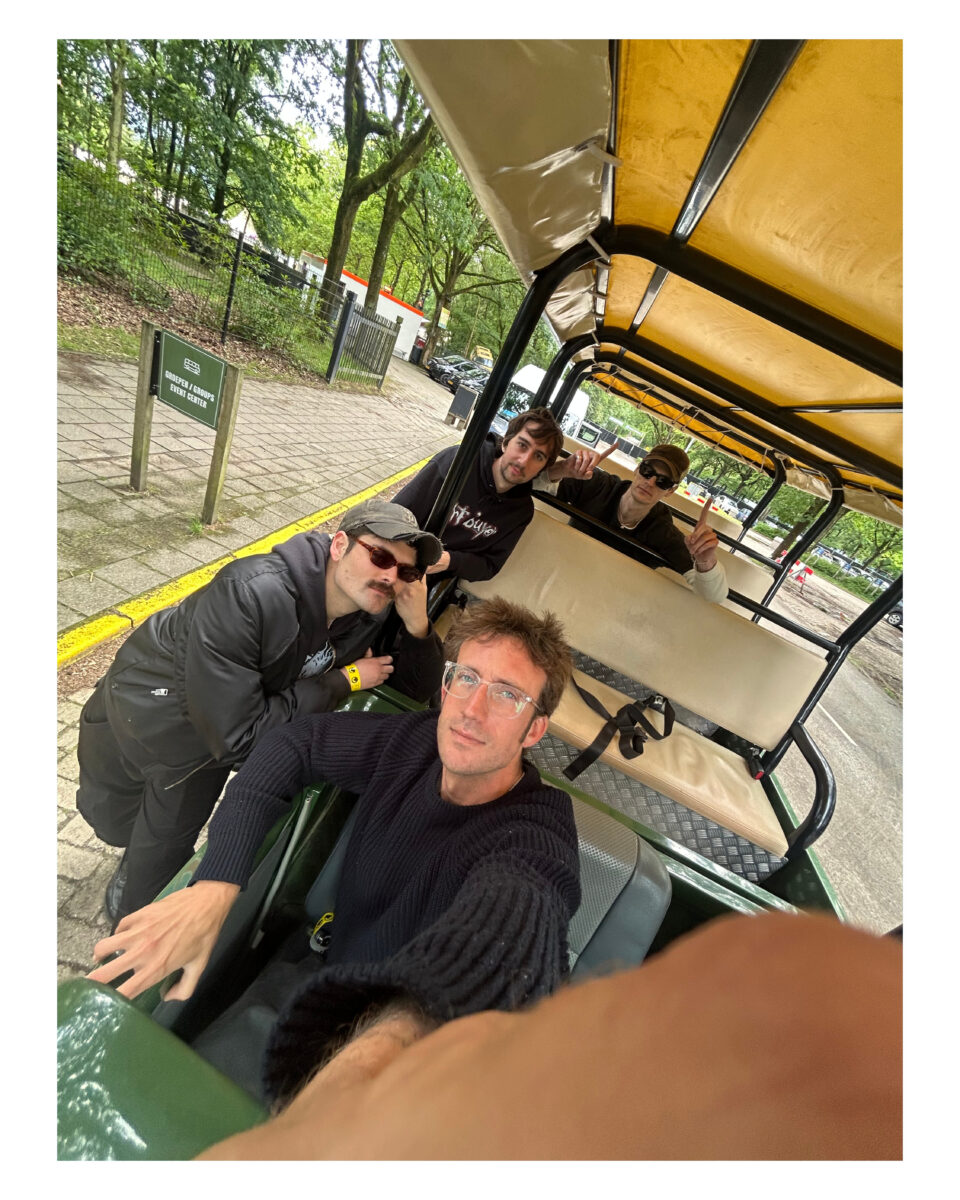
If you’ve ever left a Model/Actriz show without the distinct feeling you’ve just made four new friends, something’s amiss. Formed in Massachusetts in 2016 by drummer Ruben Radlauer, guitarist Jack Wetmore and frontman Cole Haden, the cult-followed band, now based in New York, and completed by bassist Aaron Shapiro, has emerged as one of post-punk’s most compelling propositions. Their sound draws on an idiosyncratic blend of dance-punk, industrial theatrics, guitar meltdowns and noise-rock shot through with irresistible pop instincts, as well as a near-total refusal to acknowledge the conventional boundaries between performer and crowd.
More often than not, Cole, clad in a revolving wardrobe of cabaret-meets-club-kid ensembles, from mesh gloves to frilly bonnets, abandons the stage altogether, dancing frenetically among the audience or moving through them, howling at them as he goes. With his white-hot charisma, Model/Actriz’s magnetic lead singer embodies the band’s penchant for dismantling the pedestal that so often elevates artist above fan. For them, the experience is deliberately non-hierarchical: a shared charge fuelled by apocalyptic production, queer liberation and sharply poetic lyrical ingenuity.
Still on a high from their first Coachella performance in April and now midway through a European tour, they’re taking their catalogue on the road, from the explosive highs of hypersexed 2023 debut Dogsbody – with standouts such as “Mosquito” (“With a bodycount / Higher than a mosquito”) and “Crossing Guard” (“Grind me into a pearl”) to the propulsive energy of 2025’s sophomore album Pirouette and, most recently, the moodier terrain of March’s EP, “Swan Songs”.
On one of their rare days off, Cole and Ruben dial in from a slightly hiccuping call inBordeaux, ready to talk through the art – and intimacy – of a Model/Actriz performance.
So you guys are on your EU tour right now. What have been some of the highlights of the adventure so far?
Cole Haden: Maybe our best show was in Rovereto, Italy. More than anything, it was about the crowd and us being completely in sync. That’s happened before, but of this tour, it might be my favourite. And then last night in Bordeaux, we played a small room, but it’s always special when that mystery of human connection comes alive over the course of an hour-long set. We have a day off here, too, and the weather is beautiful. It’s not a heatwave anymore.
Ruben Radlauer: Primavera [a la Ciutat] in Barcelona was a lot of fun as well – being in the city and everything, that was really special.
What’s your pre-show ritual? How do you get yourself into the right mindset before you step on stage?
CH: For me, the pre-show process starts as soon as the lights come on. Laying out the costume when I first get to the venue is the first signal to my brain that something is about to happen. Then putting it on is really important, almost like an actor preparing to approach a scene in the right mindset. I also have a mantra that I learned from a mentor about the sanctity and privilege of being on stage. Before you go on, you imagine that everyone who has ever performed there has left behind energy for you to draw on and pass on to the audience. And when you come off stage, you should have created enough energy and used enough that there’s some left behind for the next person who comes after you. That’s what I remind myself of before every show, so that I can do the best that I can each night. Then, as a group, we always have a huddle beforehand. It’s pretty brief, but we join hands, say a few words, and that’s the moment before anyone walks on stage– the true beginning of the show.
Who is the mentor who gave you the advice?
CH: His name is Ken Skrzesz – it’s a Polish name, I’d have to spell it for you – but he would be very pleased if you name-dropped him in this magazine.
I might…
CH: I don’t even know if he remembers telling me that. I was nine years old when he told me. But we just had lunch a few weeks ago, so we’re still in each other’s lives.
You played your first Coachella this year. What was that experience like?
RR: It was great, honestly. I grew up in California, so I started going to Coachella when I was 16. It was always this kind of spectre hanging over the Los Angeles music scene, so I tried to temper my expectations a little, especially because it’s not necessarily our usual crowd. But it was fantastic. The people who came out were great, everything was incredibly well run, and it definitely exceeded my expectations. I had a blast.
CH: It was the kind of show where we had a lot of friends and family come out, too. In terms of how the festival itself ran, it felt pretty similar to other festivals, but the name Coachella carries a lot of weight, and being invited to play there felt like a real milestone for us. We treated it as something special. We got custom lights, brought in our friends to do sound, and I had a special look made for the occasion. In that sense, it felt unique compared with our other shows. And because we had so many friends and family there, the whole thing felt very warm.
What do you remember most vividly about the day?
CH: We got in the day before, and while we were enjoying the festival that night, a few people came up to me. It was really special to see some of those same faces in the crowd when we played and share those moments with them. That’s really the ideal of what our shows are meant to be. People might walk into the room as strangers, but hopefully, they leave feeling like they could be friends, like they’ve shared a memory together. Through us hosting this party, there’s a sense of community that forms around the shows, andthat’s always what we’re striving for.
RR: There’s been more than 100 years of pop culture turning musicians into these inaccessible, almost mythical figures. We try to make our artistry feel approachable and rooted in who we are, to show that we’re relatively normal people making the things we make. I think that comes from wanting to bring a human face and a human touch to something that, for so long, has been defined by distance, this sense of separation between the audience, the people who enjoy music, and the people who create it. Really, we’re all just one big audience for music.
CH:I think, on the surface, the music and the shows can seem extreme. What people areoften most surprised by, though, is how human they are at the end of the day and howaccessible they feel, to use Ruben’s word.
Why is it so important to you to demystify yourselves as musicians and make your shows feel so human?
CH: Everyone in the room is there for the same reason. While we’re the ones on stage, what we gain from a show by showing up and putting our energy into it is reciprocated by what the crowd brings and gives back to us. It’s an exchange of energy that, in a way, breaks the fourth wall. It removes any sense of hierarchy or the idea that one person’s role is more important than another’s. There’s a shared responsibility to make sure everyone leaves the space feeling better than they did when they walked in.
Does the size of the crowd change anything for you mentally? Whether it’s Coachella or a much smaller room, do you prepare differently, or is the intention always the same?
RR: I think we approach them differently in terms of how we forge that connection, but the overall feeling of playing a show remains fairly consistent, regardless of the size of the crowd. The goals are always the same – to create a sense of connection.
CH: The grandiosity of certain gestures on a bigger stage wouldn’t necessarily read in the same way in a small room. The goal and the effect of the performance are meant to be the same across the board, but the way you achieve that changes. In a smaller room, you’re much more tangible as a person because you’re so close to everyone. It’s not necessarily that the movements become smaller, but you develop a different sense of humour and a different relationship with the audience than you would on a larger stage.
RR: The font changes, but the text remains the same.
CH: Exactly.I want to talk about your latest EP, “Swan Songs”.
How did the process of making it differ from Pirouette?
CH: It was much looser.
RR: “Swan Songs” was the first time in more than half a decade that we’d been able to make songs simply for the sake of making songs, without having to tie them to some larger statement. I think we just tried to have fun, maybe a simpler kind of fun than we were having with the album, because we always try to enjoy the process. There was something freeing about being able to follow ideas wherever they wanted to go, without feeling the need to build them into a bigger narrative.
CH: We made our first two albums in a very similar way. The material was written in one huge batch, and by the time we got to the studio, we already knew what it was meant to be. Everything had been created under one umbrella, with the intention of forming a larger statement. 10 years into being a band, “Swan Songs” was an attempt to shake up that workflow. I think the songs are a capsule collection that fit together, but Pirouette was a departure from Dogsbody, and “Swan Songs” is a small departure from Pirouette, and I think it’s functioning, in a way, to get us to ask the question: where do we want to go from here?
“Swan Songs” implies a final gesture. What exactly is the EP a swan song for?
CH: In a way, it was about living as though each day were your last. “Swan Songs” isn’t our final statement as a band, but we presented it very humbly to our audience ahead of what feels like a period of upheaval and transformation. We’re entering a kind of chrysalis now, and we’ll see what emerges on the other side. But those songs do feel like a statement that closes one chapter of the band.
What new lyrical territory were you interested in exploring on “Swan Songs”?
CH: On something like [our track] “Glassman”, it was about leaning more into call-and-response, background vocals and a melodic immediacy. Lyrically, it also returns to a more metaphorical, almost mythic territory, which is where I was living on Dogsbody. In a way, it marries the two albums. Dogsbody was hyper-poetic and rooted in reality, but filtered through this dream state, whereas Pirouette was much more literal. With “Swan Songs”, I was trying to bring those two approaches together. As for where we go from here, I have no idea yet. But there are these little lyrical cells in “Glassman” that can’t be performed live at this point, just because it’s me singing alone, but I was experimenting with what it would be like to record a song with more vocal texture than can be sung by one person, as if there were background singers.
How do you manage four different creative instincts and opinions while arriving at something cohesive? How do you work together as a team?
RR: That’s, in my mind, always been our biggest strength: that we have these four different creative instincts, all pushing and pulling against each other, and I think we, by sheer force of will, make it cohesive. To me, that’s what makes the band interesting. There’s no singular driving creative force, but rather a creative force that’s constantly in flux, pushing and pulling against itself.
CH:I think the tension in our music often comes not from choosing to make it tense, but from tying a knot between the four strings of our own intuition in a way that can hold strong, while always being pulled in different directions.
What’s a record that fundamentally changed the course of your life, or that has been an influence from the beginning?
CH: There’s an answer to this question. It’s just always such a hard question to answer.
RR: I’ll answer this by saying that Holding Hands With Jamie by Gilla Band was definitely the first album I heard where guitars were used in a way that showed you could make dance music, or more textural, atonal dance music with guitars. I think it exposed Jack [Wetmore] and me quite early on to a whole other world that we were already trying to claw into, just in terms of what to do, how to expand the sonic palette of the music we were making at the time, with guitars and drums too. That record changed our lives because it was validation that it could be done.
CH: My answer is Night Work by Scissor Sisters. It came out around the time I was coming to terms with my sexuality, and the album is so joyous and exuberant, all the things I didn’t feel were available to me at the time if I were to come out. That record showed me there was a life worth living on the other side of that. It takes place in New York, and it feels like the kinds of people in my life now are the people I imagined inhabiting the scenes and songs of that album. Listening to it really guided me towards the place I am now.
I need to ask you about Miley, because this magazine is a celebration of her, and she’s been such a vocal supporter of the band. What do you think she understood about the band before other people did, and how did you first meet her?
CH: We first met her at a show we played with her fiancé Maxx’s band, Lilly, at The Observatory in Santa Ana. Before we’d even exchanged words, I already knew that her favourite song at the time was “Matador” [by Model/Actriz]. I went up to her, and we ended up dancing together, singing the lyrics to it. What she understands about the band– or what she saw in us – feels not dissimilar to the energy she came onto the scene with during her Bangerz [era]: an unapologetic, fearless confidence stance in your truth. She’s also, much like what we were saying earlier about the audience being so important to us, someone who really champions her fans. There’s a kinship in that energy, for sure.
RR: Yeah, there’s always been a really strong thread in her releases of reaching for something more, of striving to go beyond what’s expected, and of jumping into the deep end without fear of expectations or meeting them. That’s something I’ve always found really admirable. It’s also how we try to approach our own creative process, to jump in and reach for something beyond what we expect of ourselves. It’s really an honour that she seems to see a kindred spirit there, because there’s a punk ethos to what she’s doing in the same way that we carry a punk ethos to what we’re doing, despite living outside of the sonic space of punk.
CH: We’re all audacious bitches.
Has she influenced you creatively or personally in any way?
CH: To sing better, for sure [laughs]. I think the kinds of statements you can make as a pop star are what I try to bring to the stages we play on. She’s such a skilled performer, and her music lives in so many different sonic spaces that when I see her perform, I’m taking inspiration and expanding the language I’ve developed on my own to further bring that kind of energy into a different type of room. But her intensity as a performer, her sincerity and her presence, are all things I really strive to bring to our shows.
What aspect of the band becomes harder to protect as the audience grows?
RR: Interesting. I think the interpersonal aspect of what we’re talking about, this desire for a fluid exchange between audience and performer, without the same separation of stage and craft, gets harder as rooms get bigger. You have to adapt the methods you use to access that communal energy and connection, and I think that will be an interesting challenge going into the next chapter: how do you convey to everyone that they are as important a part of the musical experience as anyone else, when there are so many people?
CH: That’s essentially what I was going to say.
What are you most excited about right now?
CH: I’m excited to write some new songs. What this band is, as the four of us know it, has yet to be fully revealed to everyone else. And we have a lot more to say as a band.
Exciting! Anything else to add?
CH: I’m excited for some more French wine later tonight.
WONDERLAND SUMMER 2026. GUEST EDITED BY MILEY CYRUS. SHOP NOW.
Words Ella Bardsley