Blending indie-folk with a healthy dose of existential dread, Dermot Henry finds humour in the messiness of life on his forthcoming album, Bad Throw, Good Catch.
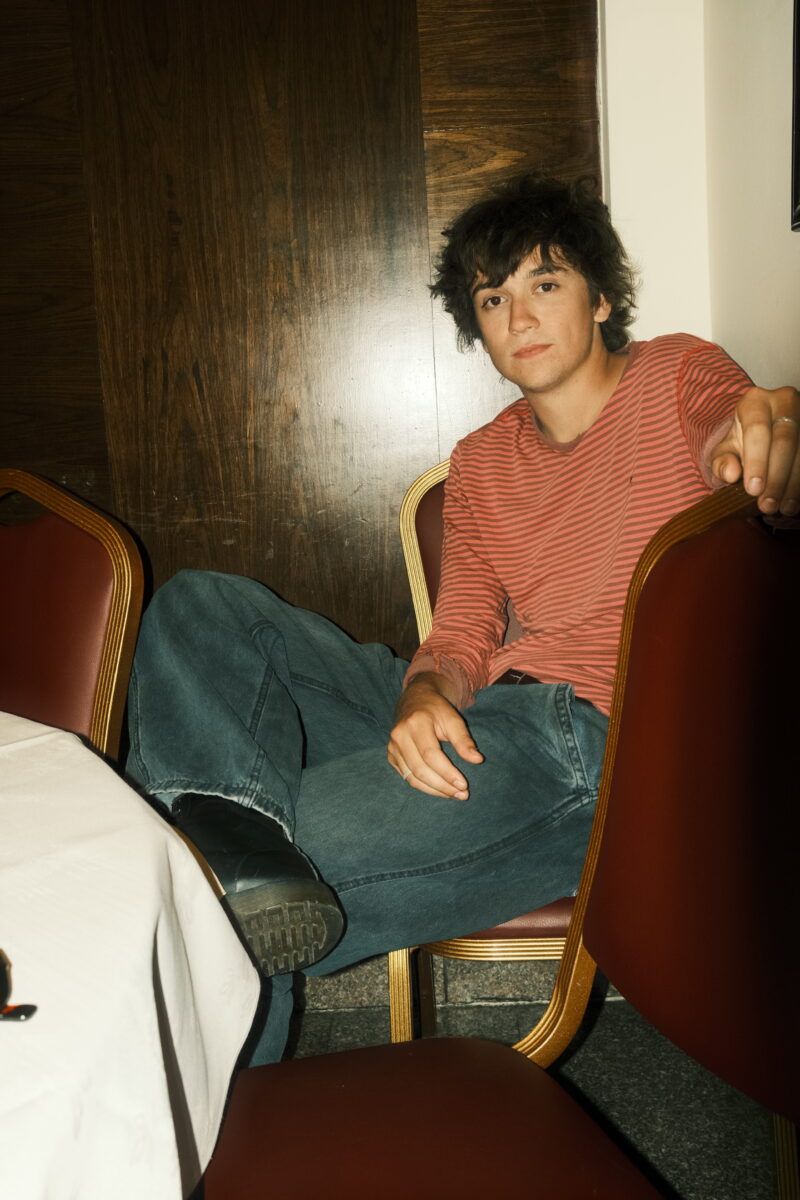
It’s a late Tuesday afternoon, and the last bits of sun are filtering through the trees outside my living room window. They catch on my sun catcher, scattering flecks of light across the room. I’m nursing a cup of tea when Dermot Henry joins the call from his bedroom. There’s something fitting about the setting: two people tucked away in their own corners of the world, talking about songs that find meaning in the everyday.
For Henry, a little existential dread never hurt anyone – especially if you can make a song out of it. The Wiltshire-born singer-songwriter has a knack for finding the absurd in the everyday, pairing candid introspection with a healthy dose of humour. There’s a lightness to the way he approaches life’s heavier questions, as though taking things a little less seriously might be the only way to get to the truth of them.
Henry first introduced listeners to his world with “Good Thing Going” in 2024. Since then, his following has grown, with “Little Rib” finding an audience online and his debut EP, “Aiming Torches At The Sun”, which came out in May this year. Now, he’s preparing to release his debut album, Bad Throw, Good Catch, out on 20 November via Island Records. If the singles are anything to go by, Henry is drawn to the strange little moments that can make an ordinary day feel extraordinary … whether that’s a passing thought, a complicated feeling or the sort of interaction that stays with you long after it’s over.
Recorded with producer Dom Monks in Frome, close to Henry’s childhood home, the album brings a more expansive sound to his introspective songwriting. Much of it was captured live to tape with his band, giving the songs room to breathe and evolve together rather than polishing them into something pristine. The record also feels distinctly personal: family members make appearances, including Henry’s mother on backing vocals and his 93-year-old grandfather singing a traditional West Country folk song on the closing track. Across warm indie-folk instrumentation, playful arrangements and piano-led melancholy, Bad Throw, Good Catch, finds Henry somewhere between Elliott Smith’s meticulous songwriting and Adrianne Lenker’s wonderfully unfiltered lyricism – without losing his own sense of humour along the way.
As Henry gets ready to put Bad Throw, Good Catch out into the world, he talks about making peace with the mess, finding the funny in the sad, and learning when to let a song simply be.
Listen to the latest single, “I Love You, That’s All”…
Read the interview…
You grew up in Wiltshire listening to The Beatles, Tom Waits, and Nina Simone, before spending a year abroad in Paris where you began busking. How did those early influences and experiences shape the musician you are today?
In every way, probably. Rediscovering the musicians I grew up with made me realise I didn’t just love them because the melodies were catchy when I was nine – they were genuinely amazing. I learned a lot from The Beatles and the vastness of their creativity.
Studying abroad in Paris made songwriting easier because I was away from everything, which somehow made me feel closer to it. I didn’t know anybody, so it felt like I was looking at my life from the outside. That space allowed me to write honestly, without hiding behind irony, jokes or characters as I’d done before. It unlocked something in my head.
Your musical heroes include Adrianne Lenker and Elliott Smith. What is it about their songwriting that resonates with you?
Adrianne Lenker was a huge turning point for me as a musician. I listened to Dragon New Warm Mountain I Believe in You for the first time when I was doing a cycle delivery job, and it was incredible. Sometimes you hear something you love and feel like you’ve always known it. I listened to “Promises of Pendulum” twenty times in a row.
I love her whimsy, wordplay, and the way she combines humour with deep sadness. She captures what it feels like to be human in such an unfiltered way. Elliott Smith inspires me through his musicianship, vocal delivery and meticulous arrangements. I love how his music ranges from stripped-back acoustic songs to more elaborate compositions. He just loved what he did so much.
You released your first single, “Good Thing Going”, in 2024 before putting out your debut EP this year. How has your relationship with making and releasing music changed?
“Good Thing Going” was quite spontaneous. I was playing in a band in Bristol and recorded it in my bedroom with my friend Kat, who also plays on the album.
Later, when industry interest picked up, I became more protective of my music. I started thinking every recording had to be the ultimate version of a song. Working with producer Dom Monks changed that perspective. I realised a recording is simply a snapshot of where you are and who you’re with at that moment. It doesn’t have to be perfect or stressful. We recorded eight or nine songs in the first week by playing them live together. I was able to have fun with my friends and enjoy the process again.
Your forthcoming album Bad Throw, Good Catch, arrives on 20th November. What does the title mean to you, and how did you approach the record?
The EP and the album were recorded together as one huge batch of songs, so choosing which tracks belonged where was difficult. The title is just a stupid joke. I’m drawn to silly ways of representing serious things, and it’s about how, even when everything feels sad, horrible or scary, what matters is who you’re surrounded by and how you deal with it.
Choosing the album tracklist was particularly challenging because no single song represented its central idea. Instead, the songs pull the record in different directions, and its meaning emerges from how they work together. The EP tracks felt too central to that overall picture, so they found their own place.
Your EP emerged from a period of distance from the people you love. Did writing the album come from a similar place of introspection, or did different experiences shape it?
The EP songs were written in Paris, while about half the album was written after I returned home. Coming back to my family, friends and hometown was just as powerful an experience as leaving them.
I’d been reading James Baldwin’s Giovanni’s Room, which explores the idea that not going home can feel more comforting than returning to an idealised place. In Paris, I’d built up a romanticised picture of home. Coming back grounded me and reminded me that the people and places I love have flaws, too. It was a lovely, if sometimes difficult, realisation.
Is there a particular song on the new album that felt especially difficult or rewarding to write?
“I Love You, That’s All” took the longest. I knew I wanted every verse to end with that line, but I had to wait for the right inspiration to finish it.
When I returned home, my grandad had just had cataract surgery and walked into the kitchen while I was sitting at the piano. The song came together shortly afterwards. I try not to overthink songwriting. Even if a lyric doesn’t feel perfect, there’s something important about preserving the way it first comes to you.
Recording was a balance of thoughtful conversations and simply playing together. I trusted the musicians’ instincts and taste, and everyone was listening and expressing themselves honestly. That level of trust requires vulnerability, and I don’t think the album would have happened in quite the same way a year earlier.
You’ve played The Great Escape, Latitude, Green Man and Boardmasters this summer and are heading out on UK and European dates. How has performing these songs changed your relationship with them?
Coming into the album was exciting because I hadn’t played with the band yet. The songs existed in a completely different way once we started performing them together. Playing live has made me fall in love with them even more, because I get to share them with people and bond with my bandmates. We’ve learned how to bounce off each other musically, and the songs keep evolving. Playing live is the best thing ever.
What have your experiences, from busking to Paris to playing festivals, taught you about the kind of artist you want to be?
Busking taught me that nobody owes you anything, which was freeing. If people walking past don’t care, you can relax and enjoy yourself. I want to be someone who pursues whatever initially drives them, like Tom Waits, who follows his instincts even when they lead somewhere strange.
When I busked with my friend Maxime in Paris, all that mattered was having fun and feeling connected. I’ve tried to bring that attitude to festivals, too. Of course I care what people think, but what’s most important is that my bandmates and I express ourselves, make each other laugh and enjoy playing. Hopefully, people feel that and love it even more.
As you look towards the release of Bad Throw, Good Catch and whatever comes next, what would you like to explore as a songwriter?
So far, I’ve approached songwriting almost entirely through instinct and intuition. Part of me wants to explore stranger things, but I don’t want to force a direction simply because I think I should. I’m still figuring out how to balance my instinct with the things I find interesting.
I haven’t written much in the past couple of months because I’ve been in the same phase of life, listening to the same things. Recently, that has started to shift. I don’t know where I’ll end up, but I want to get weird with it. That’s the goal.
Words – Daria Slikker


