Introspective and innovative, the Chicago quartet are teetering on the edge of something major. Will their soothing self-deprecation take them to the big time? Their new album suggests so.

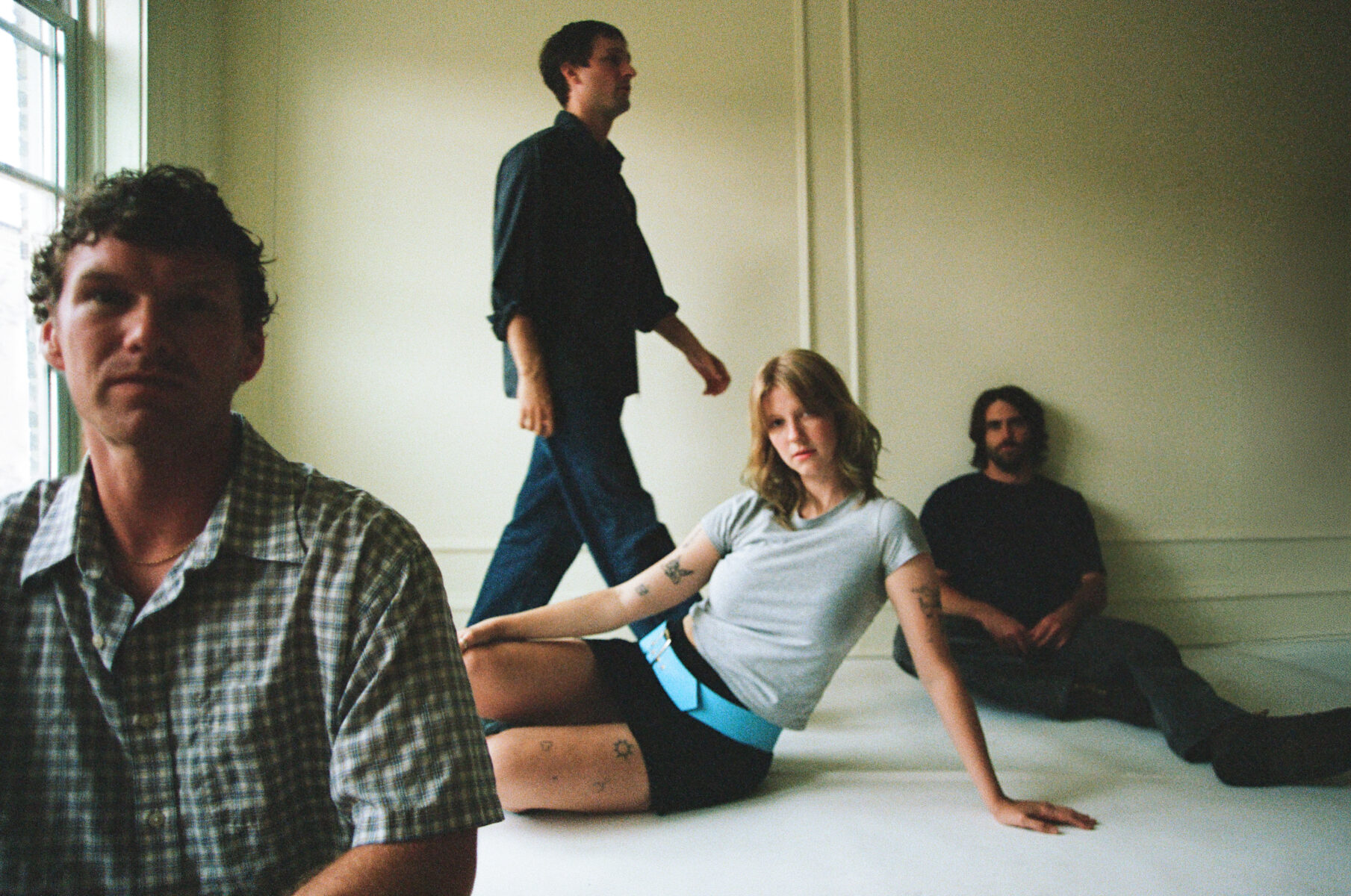
There’s an unmistakable intimacy to Chicago rockers Slow Pulp. It’s as evident via a digital encounter with the band’s vocalist Emily Massey and guitarist Henry Stoehr as it is on their new third album, Melodie, shared via ANTI RECORDS on 18th September. As the pair ease into our chat, they bounce off each other the way only old friends can do. Theirs is a creative and personal partnership nurtured by collaboration.
The band’s original members, Henry, Alex and Teddy, first met as children, bonding over their shared participation in GoodnLoud Music, a music education program run out of their local instrument shop. Massey, who grew up on the other side of Madison, joined later, first meeting Stoehr through the music scene around the University of Wisconsin – Madison. Massey would officially join the band as a member in 2017, ahead of their “EP2” release in March of that year.
Their debut album, Moveys, was built following an emotionally turbulent time for Massey. In March 2020, she was forced to return home to Madison to care for her parents, who were involved in a serious car crash. Soon after, the COVID-19 pandemic reached its nadir, and the group’s estrangement appeared inevitable.
Despite the physical distance between them, the pair, along with Alex Leeds (bass and vocals), Teddy Matthews (drums), and the group’s longtime collaborator Alex G, released an inaugural musical statement that marked their emergence as an innovative force. In the years since, they shared their second album, Yard, an emotionally charged tour through introspection, longing, and heartbreak, underscoring their capacity to digest the human experience and their willingness to traverse musical categorisation.
We speak ahead of the release of their third album and a tour that will see them play dates across North America, the UK, and Europe. On Melodie, the band chose to widen their creative process, bringing in Elliot Kozel, whose production credits include work with SZA, Rosalia, and Indigo De Souza, as a co-producer on the album, and working with New York filmmaker Ben Turok, who previously directed music videos for Tagabow, MJ Lenderman, and Knifelpay, to produce visuals for the singles “Better Man” and “Not for Nothing”.
“We have this process that Henry and I started on the first album”, Massey explains. “We would just constantly send songs to each other, every couple of days for a few months, no matter what state the song was in; we would just send it. At least for me, that let some of the fear, the worry, subside a bit”. Both Massey and Stoehr found Kozel’s influence on the project to be a liberating force. Stoehr, who led production for the band’s two previous albums, found pleasure in songwriting, a process that culminated in Melodie’s lead single, “Better Man”.
Now in his thirties and more secure in the man he has become, Stoehr wrote “Better Man” in an attempt to reconcile his past and present, and cultivate the person he wants to be, without lamenting the one he once was. The track opens with an expression of Stoehr’s characteristic self-doubt, “Did I fuck it up again ? / Maybe leave it to a better man / Who can tell himself / This is how it’s supposed to be”. For such an intimate dissection of the self, Stoehr leaves the oral expression to Massey, who provides vocals for the track. It’s a ceding of power that superficially appears backward: why pour your heart out and then hand the mic to another? For Slow Pulp, it’s second nature.
Elaborating on the decision, Stoehr explains, “As individuals, we’ve had similar personal growth stories. There’s a trust there that’s built by doing. We feel an openness and understanding, and as we’re able to do that, it minimises the fear of judgement; there’s more openness and interest”.
“And that’s something that’s been built over a decade,” Massey adds. “I think that’s something we’ve been in practice of for a long time, but we really honed in on that and allowed ourselves to be exploratory”.
As the pair digress, I’m reminded of “Falling Apart”, the breakout track of their debut album. It’s the track that first made me fall for the band’s cutting self-deprecation, a thread that tethers their musical catalogue together. “You have got to step up / Show that you can be enough / Make it ok / It’s hard to swallow / Why don’t you go back to falling apart? / You were so good at that”. The words could be taken from “Better Man”. Whilst Stoehr elaborates on their mirrored journeys to personal growth, the two tracks reveal an earlier parallel between the group’s leads. They share an inclination to resign, to pull away from a world they feel has pulled away from them, and above all, to blame themselves. This underscores their bond. Massey can extoll Stoehr’s experience of alienation on “Better Man” because six years ago, she did the same.
Sonically, Melodie covers wider terrain than the group’s two previous albums. Whilst the quartet has always been reluctant to define their sound, their previous projects had a footprint that felt grounded in early noughties indie rock. Not that Melodie is without that mark; “Spill,” the album’s penultimate track, feels aesthetically similar to their earlier work, carrying their trademark Midwestern melancholy, a trait Stoehr refers to as “attitude”. The album does, however, traverse unexplored artistic ground. Perhaps it’s their desire to widen the scope of their work, or the creative palette of Kozel, but something about Melodie feels fresh. It’s unafraid to embrace catchy, hooky melodies, though it does so in a way that preserves its offbeat edge.
Massey and Stoehr seem happy to embrace the evolution of their musical direction: “We don’t necessarily try to control what comes out. This is just the music we’re making right now; we’re happy not to police it too much”. Having Kozel join the project as a co-creator granted the quartet the bandwidth to explore new means of working together. For Massey, this meant trying her hand at production, a responsibility previously left to Stoehr, who himself found pleasure in melodic and lyrical trial and error.
For a band known for its contemplative self-criticism, there’s breezy self-confidence to Massey and Stoehr. When Moveys first brought them popular attention six years ago, they were in their mid-twenties, a time when most of us are desperately seeking an answer to the question – who the fuck am I? Melodie might not be a conclusive answer, but it can offer us some hope. It’s an invitation to enjoy the journey, to view self-discovery as exactly that, discovery. One to be nurtured, lived, and possibly enjoyed? If Moveys and Yard were the group’s escape from the race of life, Melodie is at least an attempt to reach the starting line, one step at a time.
Stoehr outlines it as such: “I think we’re reaching a point in life where you understand the importance of being direct with yourself; it’s something that’s much clearer for me now than when I was 24. Maybe there’s more of a sense of confidence in who you are, or at least, a sense of confidence in the uncertainty of life, in the uncertainty of who you are”.
It’s this trust in the process, and trust in the music that’s catalysed their evolution into adulthood. The undertaking of being a musician – it’s songwriting, hook producing, and self-exploration that have allowed the duo to reach parts of themselves that were previously contraband. “Writing usually brings out something I’ve been avoiding within myself, or didn’t have access to, something I wasn’t able to think about,” Massey says. “Then I’ll write a song, and I’ll be like, ‘that’s what was going on, exactly”.
It’s not that the need for self-dissection doesn’t scare them; both admit to fearing what they’ll find on the inside, but they’re learning to appreciate the value it brings. Massey compares it to exercising an underused yet integral limb: “It’s a muscle; once you get into the practice of it, then it becomes less scary. But when you’re out of practice, it’s a scary thought”.
Armed with a newfound self-assurance, a refreshed creative community, and the bedrock of their genuine friendship, Slow Pulp feels like a band on the cusp of big things. Their upcoming tour is their largest to date, and the lead tracks from their album have already garnered critical acclaim, and yet they seem unfazed. Maybe it’s their Chicago cool that conceals the anticipation within, or the home that Emily, Henry, Alex, and Teddy have found in each other that keeps them safe from the dizzying heights of creative acclaim. They’re not flashy, showy, or performative; their arrival is a quiet one. Despite the header of this article, their climb up the musical ranks hasn’t been a skyrocket; it’s a steady, measured ascent. A laboured, calculated rise, one that belongs to a band that one day could look down from the top, the world in their hands, and squeeze it to a pulp.
Slow Pulp’s Melodie will be released tomorrow, Friday 18th September.
Words – Toby Clarke


