Kelela is many things. Perhaps most importantly, the Afrofuturist artist is a justice seeker. With her latest album, new avatar, she takes another sonic swing at dismantling the rigidity of genre by tackling them all.
Ever since her 2013 debut mixtape, “CUT 4 ME”, both critics and fans have struggled to determine where Kelela belongs. Or, perhaps more accurately, where she exists. Instead of sitting with the slight discomfort of her vast musical world, they’ve spent years trying to box her in. R&B singer. Electronic auteur. Club music obsessive. Alternative icon. The problem, as she sees it, isn’t the desire to categorise but rather the framework used to create those categorisations.
Rather than conforming, Kelela has become someone even harder to pin down. A hyper-stylised musician with a voice that can sound both intimate and untouchable. One moment she’s a black-eyed, charcoal-skinned extraterrestrial figure onRaven’s album cover; the next she’s appearing in the music video for new avatar‘s lead single “idea 1”, off her latest album, as a wavy ice-blue, goddess-like being seemingly beamed in from another dimension. Through every incarnation, she remains unmistakably herself.
After two decades in the industry, she continues to move through admiration and critique with the same unwavering defiance, absorbing the leathery swagger of rock’n’roll, the soulfulness of jazz and blues, the eccentricity of pop and the pulse of electronic music. Her catalogue charts a sustained argument against creative boundaries.
new avatar arrived via Warp Records – the independent British record label that has spearheaded boundary-pushing artists for almost four decades – on 10th July, pushing that mission further. The record seeks to expose the invisible lines that created the genres she has spent her career blurring. But before looking outward, Kelela begins with herself. With every opportunity to interrogate these “angles”, as she calls them, she remains the same artist, merely changing frequencies to fit the chapter she’s in. This time around, the guitar becomes the sun, the instrument leading these new narratives, with soulful synths, rave-ready R&B and hypersurreal pop revolving around it. In revealing yet another side of herself, Kelela adds a new chapter to a story still being written.
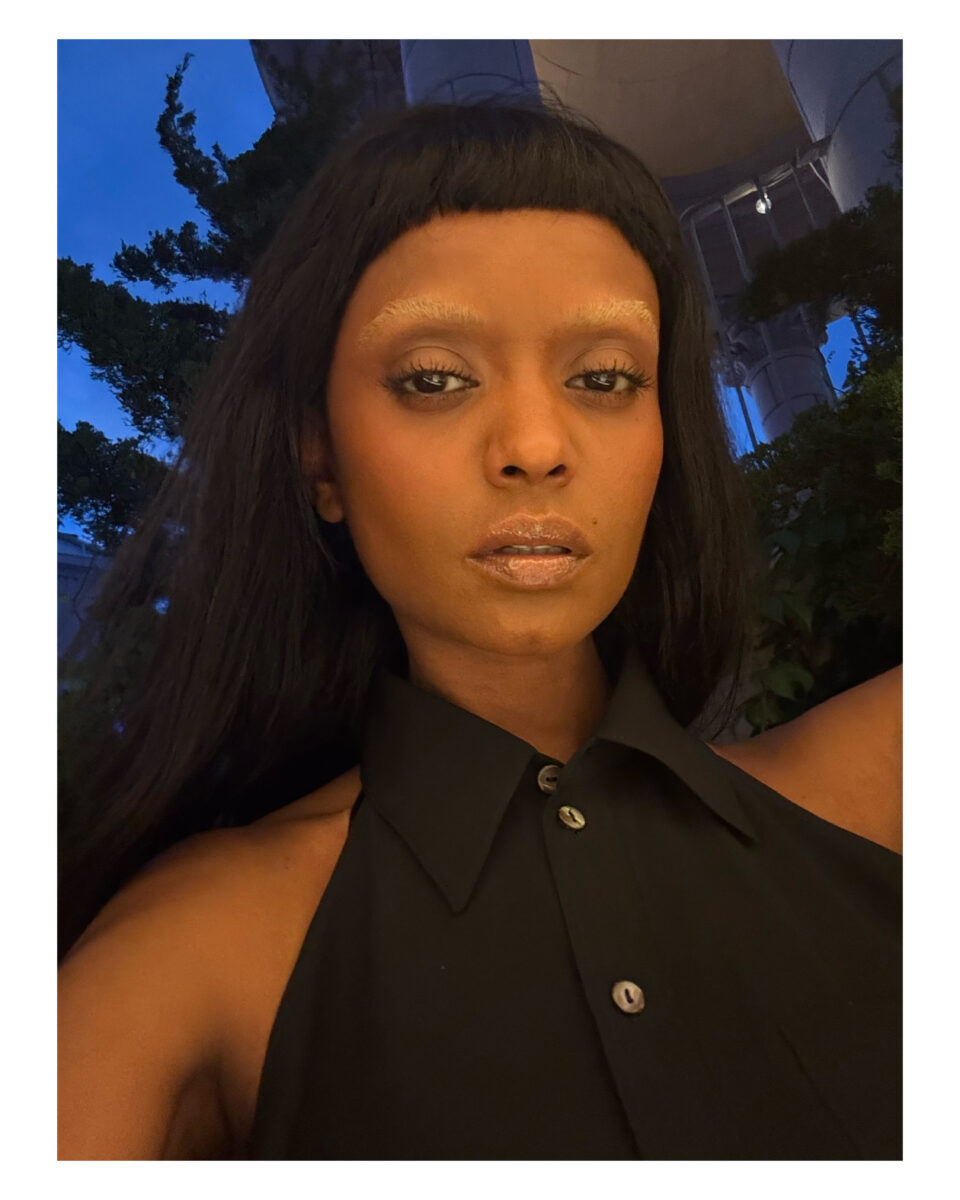
As she prepares to take her third studio album across Europe and North America, we catch her before a studio session, joint in hand. Beneath glowing skin and a heavy-fringed, jet-black wig, the multifaceted artist is preparing for yet another transformation. “My goal is to make you feel soothed into unfamiliar territory,” she says. Luckily, she’s more than happy to bring us along for the ride.
Knowing that your name translates to ‘shade’ or ‘protection’, do you feel like that sentiment has manifested in your life in certain ways?
K: I’ve always been the one paying attention to the person who’s marginalised in the room, even as a child playing with others. I feel the need to protect somebody who is unjustly dealing with consequences. As I got older and identified more with the name, I realised this is my personality. It was just a natural embodiment.
Talk to me about your latest album, new avatar. What does this record signify?
K: Where [my sophomore album] Raven was me healing away from the madness, new avatar, brings us back into the shits. I’m bumping up against and having to be more direct. So while the messaging is the same, I think it’s being delivered with a lot more conviction.
How do you navigate experimenting across genres while still maintaining a signature Kelela sound?
K: Over time, I’ve learned that my voice and approach to songwriting are enough of a thread to establish cohesion in my music. When it comes to production, I am thinking about making a more interpretive point on each record rather than being so literal about it. I have a really intimate relationship with a range of sounds, so I don’t have to think too hard about that relationship translating authentically.
The conversation around the rigidity of genre is often brought up during awards season. Meanwhile, listeners simply gravitate towards whatever sounds resonate, regardless of genre or label. How do you begin to correct those ‘wrongs’ with new avatar without forfeiting authenticity?
K: The awards system is how we solidify sonic racism. They keep moving the categories so Black people compete with each other rather than it being about sound delineations. When I started [new avatar], I came to my sessions with my White Bag playlist. I’d made it as my first point of inspiration. It was made with a lot of this in mind. Music that was sold to me as ‘white music’. It’s less about the origins of the music and more about who it was marketed to. Who’s being centred in that sound, you know? Who can expect to be centred at the show? Part of what I’m doing with new avatar is embedding this critique in the music, finding intersections that make you feel like you’re not an afterthought.
You touched on how Black women are often confined to R&B or genres perceived as “inherently Black”, even when their work clearly moves beyond that. Were there artists growing up – or at any point in your life – who were especially influential in showing you that you can do it all?
K: Janet Jackson, 100%. She’s a north star. There’s just joy. If you try to confine what that person did sonically, you’re not a serious person, and I’m not taking you seriously. You haven’t listened to her catalogue; you haven’t engaged with the range. Then there’s Kelis. For all the alt-Black girlies, that’s another north star. Stylistically, sonically, what she was bringing to the table was some shit we had not heard before, and it pulled from things outside of the ways R&B had been confined. She really expanded the whole package. Another person is Res, more directly when it comes to guitar. She’s a staple in any alt-Black girlie’s repertoire. Foundationally, there’s so much she laid down. Those are just a few pieces when it comes to Black femmes in this space, and what I’m trying to do on this record is carry that torch further.
One of your creative collaborators, stylist and image-maker Feranmi Eso, said, ‘You have to ask Kelela about her attention to detail.’ When you begin your creative process, what are you most instinctively drawn to? What comes first?
K: The first thing I’m usually doing is chasing an intersection. I’ve started in a few different ways, but it’s almost always that. I have an intersection in my mind, and I’m like, ‘Today we’re going to find the intersection between R&B and ‘X’.’ That’s pretty much always my starting point. I’m not too conceptual at the start. It’s pretty literal. I’m like, ‘What if we did this?’ The way that I sing is rooted in R&B. I have different voices within my voice, but the approach is R&B. I’m never going to try to get away from that. I think that’s a really dangerous project. For my entire career, my goal has been to show, over time, the intersection between my voice, singing and making music, and something you might think is outside of that. And when I say ‘you might think’, I mean based on how genres have been segregated. I’m trying to desegregate sounds and make sure you know that they can exist naturally and seamlessly, synergistically. That’s my mission.
There are three features on new avatar. How did those relationships come about, and what do you most admire about each featured artist?
K: A. K. Paul’s sound and approach are so up my alley. I was into it before we ever met, so coming into the studio with him felt very natural. He’s climbing a mountain from a different side. I first heard about PinkPantheress when she said, ‘K stands for Kelela,’ in another publication, and I was like, period. I listened to her and thought she was so cool. [Her debut mixtape] “To Hell With It” feels like she’s an excavator in her own right. She has an inclination to dig up things we may have forgotten about – she’s like post-Craig David pop; vocally, you can name so many references. But it’s important to say that she has so beautifully referenced what he laid down without staying there. When she asked me to be on her “Bury Me” record, she knew the one to get me on.
With Foushée, I’ve been a fan. Her first album [softCORE] was incredible. I remember where I was when I heard it. Her second album, Pointy Heights…Just so brilliant. She does a really good job of exploring her origins in a way that isn’t literal. Some of the most incredible intersections and interpretations of Jamaican-born music live there, music that’s overlooked and never really synthesised so well. She actually chose the track she’s on [on new avatar]. I thought she might want one of the guitar-forward ones, but she was like, ‘I want to get on this one.’ I was like, ‘Period, she’s about to get in her rap bag.’ She slid so hard on that verse. Each of them are visionaries. Each of them tore me out. They have ideas beyond being good songwriters. They know what intersections they want to articulate. That’s the key ingredient for me, as a music maker and as a listener. I feel really honoured not just to have them as names, but as people who embody the ethic I’m trying to move through this world with.
This is a Miley guest-edited issue, which means she selected you as one of her favourite artists. When you think of Miley, what comes to mind? Do you have a favourite song of hers?
K: First of all, Miley has a beautiful voice. Her tone has always felt so mature, even when she was really young. It sounds like she’s seen some things. On some Stevie Nicks shit. She emotes with an urgency that really grabs me. She sings. There have been so many iterations of her, and I appreciate her willingness to move through and change her mind. She’s also trying to express different parts of herself. In terms of a favourite song…Mine would be “Rooting for My Baby” from Bangerz. [Plays the song from her phone and immediately starts groovin’.]
You’re heading on tour across North America and Europe. From your perspective, what is a Kelela show like? How would you describe it?
K: My hope is that it’s different every time. When someone describes a previous show, it won’t be how the next person experiences me. I want you to leave feeling more inspired to be emotionally courageous through the display of vulnerability in my performance. On the Raven tour, I was the singular thing in the show. There was no band, no nothing– literally me and lights. It took a lot of courage to lean into that, but there’s so much you can get from an experience like that. I want you to feel touched. That’s the thread.
How does that vision evolve for this new avatar era?
K: I’m definitely coming out with a band. I’ve never toured with the guitar as the lead instrument, and I’ve never toured with a drummer. I’m really excited to bring forward this other facet of my performance chops and get into that. Another goal with this era is intertwining the previous catalogue so you feel like you can’t decide whether this is a rave or whether we’re supposed to mosh right now. I want you oscillating between the two, feeling like you’re seamlessly going from one type of show to another. So…It’s a whirlwind.
WONDERLAND SUMMER 2026. GUEST EDITED BY MILEY CYRUS. SHOP NOW.
Words Aswan Magumbe