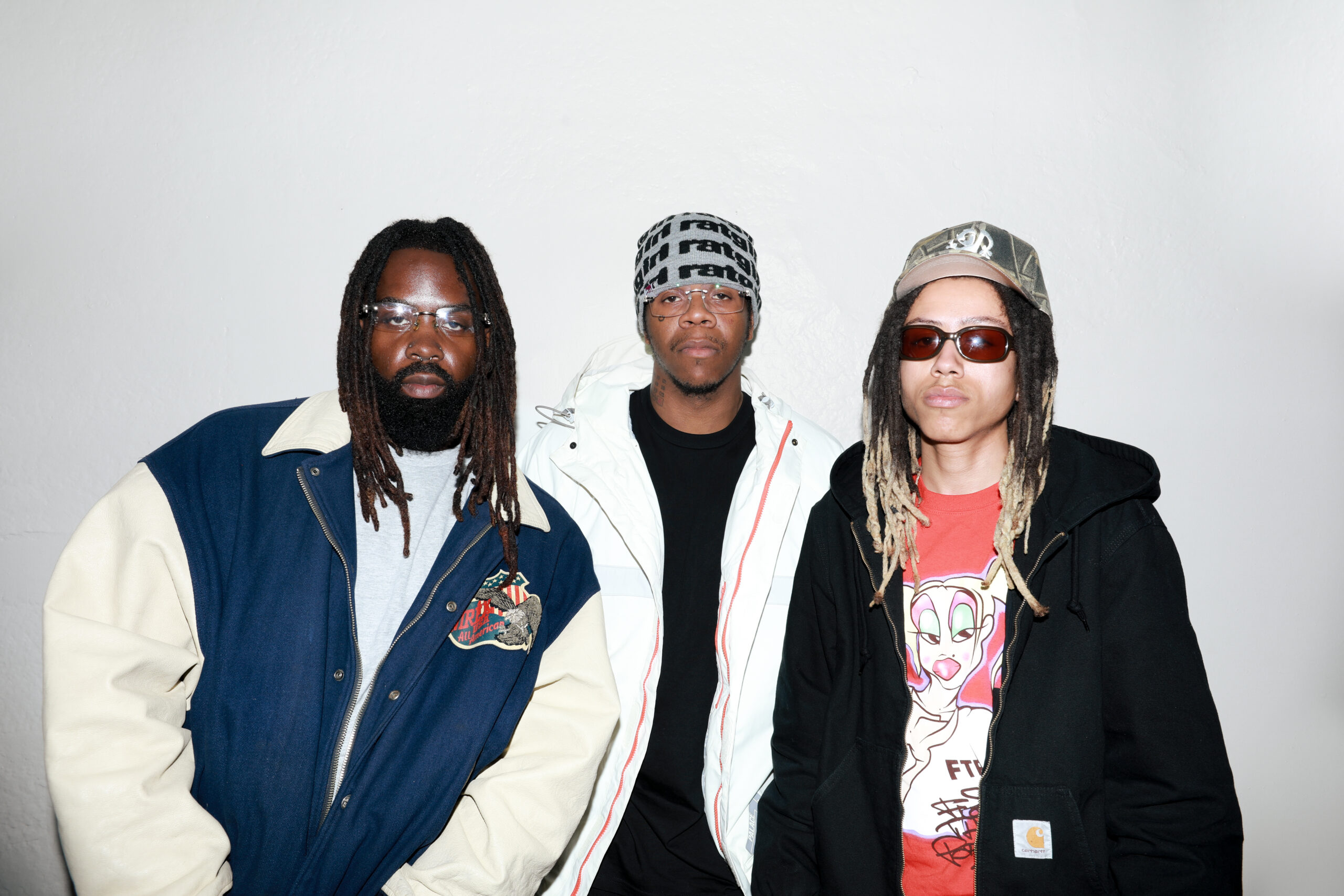
The Detroit cult favourites and ghetto-tech aficionados are putting their city and their genre on the map. Outrageous yet profound, star-quality flows through the trio’s music and attitude. Wonderland Features Editor Ben Tibbits meets them in Shoreditch, discussing their gloriously chaotic live show, changing club culture, and their re-released albums.
“We want everyone to have a good time,” King Milo, the most outspoken of the three members of Detroit outfit HiTech, states through mouthfuls of chicken. He’s discussing the trio’s infamous live shows. “We want people to—this is what we always say—release their inhibitions, and just let go. To be in it, till you don’t recognise anything that’s going on outside. Sometimes it’s about getting out of your comfort [zone]; there’s a lot of fucking freaks, and sometimes that can be overwhelming. But I like it, I’m a freak.”
Emerging artists can be talented, and they can have bags of potential, but HiTech feels different. They are genuinely exciting. From relatively obscurity—within the UK press stratosphere at least—six months prior, they quickly became inescapable this spring and summer, popping up across the festival circuit (I saw them myself at Primavera at 4:30am, a raucous experience), and developing a cult status that most acts would take zeniths to nurture. “They conform to us,” the conversational Milo smirks in valiant disregard of the industry status quo. “You can’t go around swinging your dick saying ‘I got the biggest dick,’ when you already got three n***a’s with the biggest dicks.”
I’m in Shoreditch, enjoying a black Americano in the restaurant of the hotel where the group are staying whilst they stop off in London. The three-piece are over in Europe to spread the HiTech manifesto, “bottle by bottle, city by city, titty by titty.” The aforementioned Milo—brash, boisterous, hilarious—orders a comprehensive banquet for lunch, whilst the other two members stick to a tall, green smoothie. 47Chops, HiTech’s resident beatsmith and spinner, amusingly regrets his decision once he sees Milo’s devilishly tasty-looking platter, helping himself to the odd mouthful. Milf Melly is the quieter Tech-alumni, measured in his responses, popping up with the odd profound comment. Their individual roles? Milo defines them as such: “[Chops] is the past, because he has the knowledge and understanding of all that we do and are trying to do. I’m the present, because in the moment is where I stand with everything, and I like [the music] to be modernised so it can be understandable. [Melly] is the future—he knows what’s going to come next. He feels it out, he’s empathic to the sound.”
It’s sometimes difficult to tell if the trio, sporting deep intonations of elongated vowels and quirky Americanisms, are being serious. “We just crack a lot of jokes,” Milo shrugs. It’s—in all honesty—a gorgeous change of pace from the monotonous media-trained majority, and a test of my own guile. The HiTech triangle met, according to Milo, during “a very all-inclusive party,” at “Pound Town”. It’s one of two establishments that carry the name in Detroit, Chops interjects: “There’s the freaky one and the fishing one.” A bond of friendship—which they now place closer to brotherhood—developed and flourished even prior to music being part of the equation. “Before anything went down, we were just there, kickin it,” Milo recalls. “We found out we all did music, and had heard about each other before, because it’s all one scene. Detroit’s big but it’s small. It was rap first, but that’s how I started. I’ve been making music for years, [Melly] too, and [Chops] has been spinning. We just got together and started putting together this sound.”
From rap origins, HiTech have traversed into something eccentric and sonically disparate. And yet the group is defined within rap’s parameters more often than not. Milo doesn’t see that as a surprise though, given their braggadocious effervescence and pop culture capturing quintessence. “We’re not a rap trio, at all,” he reasons. “But people might describe us at that because of how we seem. We’re young, fresh ass n***a’s, the body language screams hip hop and trap. But it’s really just what resonates, and it’s how we’re coming off. To a degree it’s adding onto the intention behind what we’re trying to do.”
Nowadays, their broad aspirations cover “trying to change club culture—break it down, build it back up, put stilts on it and let it walk,” but originally, carving out a sound and building a sonic identity was only as important as the catharsis that enveloped them whilst making it. “Our music is made with intention, but it wasn’t the intention for everybody at first,” Milo reflects. “It was to escape. We’re making songs that are fully indigenous of Detroit, but we didn’t realise at the time, we made it to escape what we’d been dealing with. Shit gets real wherever, but whatever street we were on at that time, it was real as fuck. So we were trying to use the home realm, and we played to the strength of expression. And I think it’s because of that, and how we can make you dance at the same time, that means you can relate.”
Such motives lie in the three members’ geographical roots. From Ford to rectangular pan pizza, Detroit is an intriguing and influential city; its quietly prodigious impact tangible across the globe. The city holds a fair stake in Western contemporary music; from the birth of Motown Records to early punk and, most significantly for this tale, the inception of techno music. Since its 80s origins, the genre has found new pockets to explore and sub-styles to define, but the core ethos—the captivity of the imagination, finding beauty in the technical—remains. For HiTech, it’s defined as ‘ghetto-tech’—an amalgamation of electro, techno, Miami bass, trap, made for sweaty no-judgement basements and dazzlingly dingy dance floor. “It’s a grittiness, high energy,” defines Chops. “Before people were actually producing the beats, people would DJ and just speed the tracks up till they had that high bpm, and then mix it in with hip hop or other genres to create that vibe. We [Detroit] have always had that bubble, that is closed off from everything else that’s going on around us.” Melly offers a more emotive standpoint: “Real life events type shit, just expressed on a beat,” is how he labels the phenomena, which HiTech put “a new twist on,” he continues. “With this type of music you just gotta live throughout your music. Everything that we’re saying, we basically already did or we’re going to.”
In July, HiTech re-released their self-titled debut album and its follow up LP, Détwat. The two records originally came out in 2022 and 2023 respectively, before disappearing from streamers in murky circumstances. It all adds to the mystery that circles the trio, and now that the albums have returned to DSP, it feels like a new release in itself. “Those are our babies, man,” says Melly. “I’m glad that they’re out so everybody who hasn’t experienced it gets to experience it,” Milo agrees. And the homies get to take it back in. Everybody spreading it. People can know what the fuck we about, can know what the fuck we about. We’re just taking it and rubbing it in like butter, it’s all good.” There’s not much between the two albums in terms of quality—both are riotous, rigorous, challenging and hi-octane works, jam-packed with well curated features and ghetto-tech characteristics worked into a modernised melting pot that flirts with hip hop (especially the sophomore) and Chicago house. Collectivity and community flow through the records’ creative process, and HiTech’s artistic ethos in general. Rather than chase collaborators who would bring more attention to the trio in the short term, HiTech wanted to put shine on the people around them, enlisting friends—some of whom aren’t artists or musicians themselves—to feature across the records. “It’s so we can get the people who aren’t being heard to be listened to,” Milo says. “That’s the whole point. Our first tape wasn’t a bunch of n***a’s who we thought, ‘oh we gotta go and get so and so because they’re big.’ Nah, we grabbed some homies, some home girls and just people around us. We had homies that aren’t even doing music like that. Everybody got shit to say. This is just for everybody who ain’t being heard.”
With a tour supporting Nia Archives—who the band met when the Mancunian frequented Detroit last year—across the States, the UK and Europe already underway and sprawling across much of autumn, HiTech’s reputation continues to aggrandise. In September, they shared “Spank”, their first new music signed to Loma Vista Recordings. The track is a frisky, frivolous effigy of sorts, a cut that could easily be ridiculous if done without the proper nuance, but in this case plays out like high art. But that’s just the HiTech MO, isn’t it? Then, a new project. “For the mixtape, we’re staying home,” Milo teases. “That shit for the streets. It’s for the culture. That tape is gonna be a vibe.”
Emblematic of their city, the ghetto-tech genre and of inclusive hedonism, HiTech has to be seen and heard to be believed. Authentic and adventurous, Milo, Melly and Chops approach their ambitions in a wholly unique way. And one thing is for sure—whatever they come across, they will remain united. “We’ll never make each other feel like our statement and our mission is insignificant,” Milo says as he pushes his empty plate to one side. “All three of us have this perspective of the situation, and we won’t be alone. We’re not going to falter.”
Related → Related → Related → Related → Related → Related → Related → Related → Related → Related → Related → Related → Related → Related → Related → Related → Related → Related → Related → Related →